Football seasons can live long in the memory for many reasons. Club supporters will rely on their own team’s successes or failures to measure each season. The broader football-watching and the sport’s historians will craft narratives that can be revisited time and again, narratives that true or not become the measure of a how a season is remembered as time softens the true memories of a football season long ago.
Over the past couple of years I’ve been collecting and collating a wide variety of football data. And I began to wonder: so much of data analysis in sports looks at individual and team performance but can we also measure seasons? Can we use data, instead of rose-tinged memories and Wikipedia entries, to objectively identify which seasons were the most exciting, which ones were the most dramatic?
Of course, first we need to try to measure excitement. I decided to look at three general dimensions: the title race, the relegation battle, and everything else. The following sections spend a decent amount of time exploring different metrics which, perhaps, lend themselves to measuring the inherent drama of a season. Unless otherwise noted, each metric covers the second half of the season instead of the full season. I’ve made a simple assumption that seasons are more dramatic and memorable in more for what happens in the second half instead of through their full course.
It’s worth noting that, for the author, the purpose of writing this article was as much the exploration of the metrics and using them to uncover interesting trends from the past as it was with developing an actual ranking. I am by no means a mathematician nor a statistician, and there will perhaps a couple of areas where a data scientist may shake their head in bewilderment at certain methodologies. I certainly enjoyed diving into the metrics and learning more about Premier League history, especially the earlier years, and it is my fervent hope that some casual fan stumbles upon this article and finds some entertainment in it.
In any case, the article is rather long so for those who wish to see the final rankings I have provided a useful menu.
Jump to: Middle of the Pack | Relegation Battle | Title Race | The Final Rankings
The Middle of the Pack
In my humble opinion, the positional jostling of clubs in the middle of the table will always have a lesser impact on the overall drama of a season. And that makes sense – there is little to play for except pride of place and additional prize money. Sure, I’m downplaying the impact of reaching Europe for a so-called smaller club’s fan base but in general there is lack of interest – or at least a significantly lower level of interest – in who finishes in a Europa League place, let alone who finishes in 10th or 13th place.
That being said, let’s still take a look at a couple of factors that may provide insight into how entertaining and volatile a season is.
Total number of positional changes
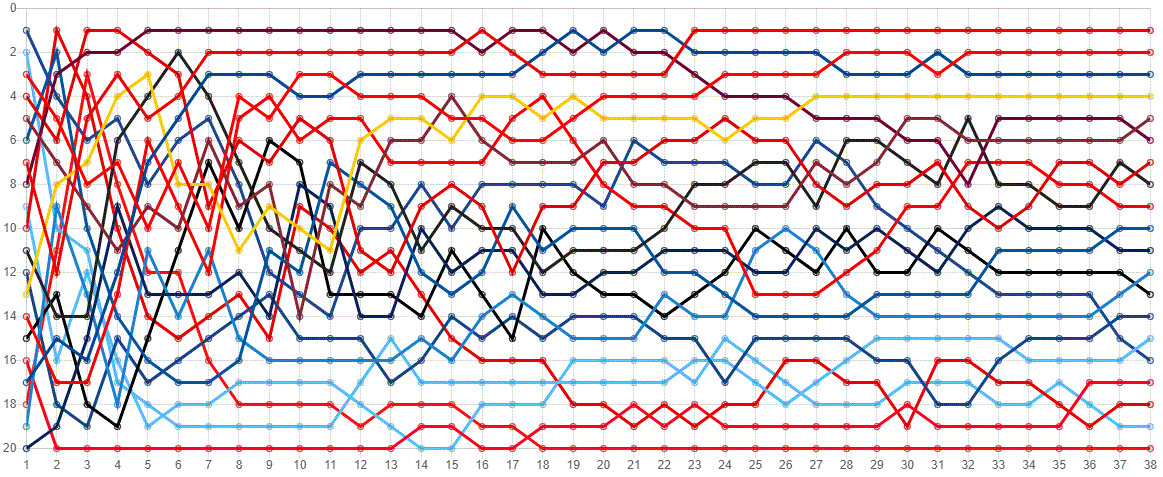
This was actually the measure that first got me thinking about this topic overall. On my football site, I built a chart that showed the progression of each club’s position over the course of a season. It’s an interesting albeit very busy way to track a club’s season-long journey. You can begin to see that some seasons are much more volatile than others. To provide a visual, here are the least and most volatile seasons.
2000/01 season 1992/93 season
You can see how much messier the bottom chart is – especially after the seasons gets into a groove after the first 10 weeks or so. Does this translate into a more exciting season? A season certainly won’t be remembered for the dynamism of positioning from the 7th to the 13th spots but a more volatile league does imply more parity – and hence more uncertainty in matchups week to week. Such a theory could perhaps be further explored using historical betting data.
The metric of number of positional changes is straightforward. If a team has a new position in the table after a week of matches, then that is a positional change. The overall metric counts the sum of changes throughout all of the positions in the table. I’ve taken only the second half of the season to try to weed out the noise of earlier weeks. I’ve also normalized the metric to be a by week measurement given the first three Premier League seasons were contested over 42 weeks.
| Most Positional Changes (Second Half of Season) | |
| 1992/93 | 12.43/week |
| 1993/94, 1994/95 | 10.62/week |
| 2010/11 | 10.53/week |
| Fewest Positional Changes (Second Half of Season) | |
| 1999/00 | 6.89/week |
| 2009/10 | 7.05/week |
| 1995/96 | 7.21/week |
What’s quite interesting is that the most volatile seasons were the first three of the Premier League. One possible and perhaps cynical conclusion could be that the creation of the Premier League has turned English football into a less equitable and less dramatic competition. The trend of the positional change metric would support such a conclusion, given that only three of the past 15 seasons were in the upper 50th percentile in changes per week. Meanwhile, six of the first seven seasons were in the upper 50th percentile and four of the first five in the upper 85th percentile.
The Race for the Champions League
Outside of the title race and the relegation battle, the key narrative that drives interest (and marketing) is the determination of who will make the Champions League. Besides the prestige of participation in continental football, for many clubs this has become a requirement to remain financially and culturally relevant and for others a holy grail to try to break a monopoly of a Big Four (that eventually turned into a Big Six).
Unfortunately, few clubs replicate Galahad’s success and reach that holy grail. In the 17 seasons beginning with 2002/03 that the Premier League has sent their top four to the Champions League, only Newcastle, Everton, and Leicester have managed the feat outside of the Big Six – and each have accomplished it only once.
| Team | Number of Top Four Finishes (Since 2002/03 season) |
| Arsenal | 14 |
| Chelsea | 14 |
| Manchester United | 13 |
| Manchester City | 9 |
| Liverpool | 9 |
| Tottenham Hotspur | 6 |
| Newcastle United | 1 |
| Everton | 1 |
| Leicester City | 1 |
I thought it might be interesting to look at the composition of the Top Four throughout the Premier League’s history. 14 clubs compose the list with all four of the clubs with multiple Top Four finishes outside of the Big Six having since fell on hard times of various degrees. Indeed, the only teams not in the Big Six that have had moderate success recently are Everton and Leicester – where moderate success means plying their trade in the Premier League without the existential threat of relegation looming at the start of every season.
| Team | Number of Top Four Finishes (All-Time) |
| Manchester United | 23 |
| Arsenal | 21 |
| Liverpool | 16 |
| Chelsea | 16 |
| Manchester City | 9 |
| Tottenham Hotspur | 6 |
| Newcastle United | 5 |
| Blackburn Rovers | 3 |
| Leeds United | 3 |
| Aston Villa | 2 |
| Norwich City | 1 |
| Nottingham Forest | 1 |
| Everton | 1 |
| Leicester City | 1 |
Nevertheless, let’s make an attempt at measuring the drama of a Top Four battle. I use a simple metric, number of changes in the Top Four. This is nothing more than the number of differences in the composition, i.e. the number of replacements, of the top four spots . The more changes, the more competitive the race. I’ve looked at the number of changes in the second half of the season only and the rankings only take into account the seasons starting from 2002/03.
| Most Changes in the Top Four Places (Second Half of Season) | |
| 2003/04 | 9 in 19 weeks (0.47/week) |
| 2009/10 | 8 in 19 weeks (0.42/week) |
| 2018/19 | 7 in 19 weeks (0.37/week) |
| Fewest Changes in the Top Four Places (Second Half of Season) | |
| 2004/05, 2015/16 | 0 |
| 2008/09, 2014/15, 2017/18 | 1 in 19 weeks (0.05/week) |
What’s pretty obvious is that you don’t really see too much change at all in the top four. Even with a Big Six, the first four places in a season are pretty well settled by the halfway point of a season. That’s true even of the hugely disruptive 2015/16 when Leicester won the title. Sure, there was movement within the top four but the same clubs that were in the top four places in Week 19 didn’t drop out for the remainder of the season.
Jump to: Middle of the Pack | Relegation Battle | Title Race | The Final Rankings
Relegation Battle
Number of teams in the relegation zone
This is a straightforward metric – it’s simply a count of the teams that resided in the bottom spots at some point in the second half of the seasons. The idea here is simple: the higher the count, the more fan bases fretting at some point in the run-in that their beloved sides might face the drop and therefore more drama.
Unfortunately, this metric doesn’t provide too much differentiation. The highest count is the 1994/95 season when eight teams at some point were in the lowest three positions over the second half of the season. Six other seasons had seven teams at one point threatened with relegation, the most recent 2017/18.
| Seasons | Count | Teams |
| 1994/95 | 10 | Aston Villa, Coventry City, Crystal Palace, Everton, Ipswich Town, Leicester City, Manchester City, Norwich City, Southampton, West Ham United |
| 2007/08 | 7 | Birmingham City, Bolton Wanderers, Derby County, Fulham, Reading, Sunderland, Wigan Athletic |
| 2008/09 | 7 | Blackburn Rovers, Hull City, Middlesbrough, Newcastle United, Stoke City, Tottenham Hotspur, West Bromwich Albion |
| 2010/11 | 7 | Aston Villa, Birmingham City, Blackpool, Fulham, West Ham United, Wigan Athletic, Wolverhampton Wanderers |
| 2013/14 | 7 | Cardiff City, Crystal Palace, Fulham, Norwich City, Sunderland, West Bromwich Albion, West Ham United |
| 2014/15 | 7 | Aston Villa, Burnley, Crystal Palace, Hull City, Leicester City, Queens Park Rangers, Sunderland |
| 2017/18 | 7 | AFC Bournemouth, Crystal Palace, Huddersfield Town, Southampton, Stoke City, Swansea City, West Bromwich Albion |
Number of changes in the relegation zone
This is the sum total of changes to the composition of the relegation zone over the weeks. For example, if two out of three teams in the bottom three spots changes in a week, then the total for that week is two. This measures the week-to-week excitement of the relegation battle. One might expect this metric and the one above to be closely related but they turn out only to have 55% correlated so it’s a useful measure to look at.
And, indeed, with this metric we see a little more differentiation. The 2011/12 season was the most volatile at the bottom when 12 changes occurred over the final 19 weeks. 2010/11 and 2017/18 each had 10 changes. While there is differentiation among seasons, the metric still shows that even the most dramatic seasons average around only one change every two weeks – which doesn’t feel very exciting on paper. Still, it’s much better than 2002/2003, when West Ham, West Brom, and Sunderland were the only teams in the relegation zone for the full second half of the season.
| Most Changes in the Relegation Places (Second Half of Season) | |
| 2011/12 | 12 in 19 weeks (0.63/week) |
| 2010/11 | 10 in 19 weeks (0.53/week) |
| 2017/18 | 10 in 19 weeks (0.53/week) |
| Fewest Changes in the Relegation Places (Second Half of Season) | |
| 2002/03 | 0 |
| 2000/01 | 2 in 19 weeks (0.11/week) |
| 1999/00, 2001/02, 2003/04, 2005/06, 2006/07 | 4 in 19 weeks (.21/week) |
Great Escapes (or Bitter Heartbreaks)
The real drama of a relegation battle comes on the final match day. This is where ninety minutes of football can undo (or justify) the 3300+ minutes that came before it. This time I was able to take into account the four relegation spots in 1994/95 and found that great escapes have happened seven times in Premier League history. Everton and Wigan have both managed it twice. Sheffield United fans have seen their hopes dashed in the cruelest of ways twice – in 1993/94 and 2006/07.
| Season | Relegated Team | Escaping Team |
| 1992/93 | Crystal Palace | Oldham Athletic |
| 1993/94 | Sheffield United | Everton |
| 1997/98 | Bolton Wanderers | Everton |
| 1999/00 | Wimbledon | Bradford City |
| 2004/05 | Norwich City | West Bromwich Albion |
| 2006/07 | Sheffield United | Wigan Athletic |
| 2010/11 | Birmingham City | Wigan Athletic |
The 2006/07 season shows the particular difficulty of trying to gauge drama by just looking at the data. That season had the third-fewest changes to the composition of the relegation teams but the final two weeks were filled with drama. West Ham, who had been in the relegation places for 22 consecutive weeks, clawed their way out with two weeks to spare. Wigan entered the final week in a relegation spot for the first time that season. And Sheffield United, the team that were ultimately relegated, were in fifteenth with two games to go. The long-term volatility of the relegation battle indicates a ho-hum race to the bottom but the actual drama of the last two weeks belies that assertion.
Jump to: Middle of the Pack | Relegation Battle | Title Race | The Final Rankings
The Title Race
This is the element of a season that is the most important, the one that holds the most potential for drama, the one that determines how seasons are remembered and ranked. The title race is how reputations are forged and narratives become mythologies. Some seasons are memorialized for reasons other than the drama of the title race: Arsenal’s Invincibles in 2003/04, Leicester City’s fairy tale in 2015/16, and Liverpool’s current, pandemic-interrupted romp to their first Premier League title come to mind.
Then there are others that are remembered for the thrilling finales and the breathtaking finishes. The ones where the tension is taut, where things fall apart, where hearts are broken and triumph and glory reigns, and where legends are forged, ready to be told in years ever after to grandchildren sitting on knees. Keevin Keegan’s famous “I will love it” rant. Sergio Aguero’s title-winning goal in the last minute of the last game. Manchester City and Liverpool matching wins for nine straight weeks to close the season.
Those are the ones we’ll try to uncover through the data. Do the metrics really help us determine which title races are the most dramatic or is it a futile attempt at measuring the unmeasurable? Let’s take a look.
Separation Score
The separation score is a simple metric I initially created to quantify the dominance of a champion but I use it more often to explore the trajectory of a team’s season. It’s meant to measure distances relative to first place. It’s the first metric I display on my football site and, despite its simplicity and some obvious drawbacks, I’m rather fond of it.
Like all other metrics in this post, the math is straightforward though the explanation a bit more involved. The separation score is a measure of distances. Any team that is not in first place is assigned a negative score with a value equal to the number of points they are off of the top. The team in first place is assigned a positive score with a value equal to the number of points they are ahead of the second place team. Those scores are summed up across the weeks of a season for a single separation score, or plotted on a chart to show a trend.
There is no normalization involved – not for the number of points available, not for the number of weeks. It’s a directional value and one I enjoy more in its visualization then in its value as a single number. Here are the charts for the highest and lowest separation scores of any Premier League champion.
Manchester City – 2017/18 (Separation Score: 386)

Manchester United – 1995/96 (Separation Score: -147)

The utility of the visualization is you can see the trajectory of a champion’s progress toward the title. Manchester City took control by the eighth week and kept building on their lead – leading to the most dominant performance by a champion in Premier League history (and a record-breaking 100 points).
Manchester United’s trajectory, meanwhile, is their famous campaign where they chased down Newcastle from 12 points behind. They spent so long outside of the top spot – and were so far behind for so long – that they made for very unlikely champions.
Obviously the second season is the more dramatic and hence lower – ideally negative – separation scores help to indicate exciting and drama-filled campaigns. Here is the list of the lowest and highest separation scores. While the charts above show the full-season trajectory, for the table below I have looked at the separation scores from the half-way mark – this is to be consistent with a standard I’ve used throughout this writing. (I also noticed that by using full-season scores I had omitted Manchester City coming back from eight points down in Week 32 of the 2011/12 season, which would have been a grave oversight indeed).
| Lowest Separation Scores with Season and Champion | ||
| 1995/96 | Manchester United | -75 |
| 1997/98 | Arsenal | -32 |
| 2002/03 | Manchester United | -31 |
| 2018/19 | Manchester City | -22 |
| 2011/12 | Manchester City | -14 |
| Highest Separation Scores with Season and Champion | ||
| 2017/18 | Manchester City | 292 |
| 2000/01 | Manchester United | 241 |
| 2005/06 | Chelsea | 213 |
| 2012/13 | Manchester United | 202 |
| 2004/05 | Chelsea | 188 |
Unsurprisingly, the legendary 1995/96 Manchester United campaign has the lowest score. Arsenal’s 1997/98 season takes second place: 12 points behind in week 20 and ten weeks later in week 30 they were in first place. Their meteoric rise continued as five weeks later they had opened up a seven point lead. Their eventual one-point margin over Manchester United is a bit misleading given they lost their last two games having already guaranteed the title.
The 2011/12 Manchester City side with its dramatic chase-down and last minute title winning goal actually ranks lower than the 2018/19 team. They were eight points down in week 32 and back level in week 36. But they had spent a good portion in first place before a precipitous decline began in week 27, when they were two points up before falling to eight behind in week 32. The next team on the list would have been Manchester City’s 2013/14 title winners – which means that three out of City’s four triumphs have involved chasing from behind. The fourth of course was the utterly dominant 2017/18 season, which has the highest separation score by far of any Premier League season.
Lead Changes
The separation score discovers those champions that came back from significant deficits to win the title in dramatic fashion but it doesn’t necessarily capture the drama of a neck-to-neck race. For that we’ll take a look at a pretty simple measure similar to those explored in previous section: the number of times the top spot changed hands.
| Season | Champion | Number of Changes in the Top Spot |
| 2001/02 | Arsenal | 7 times in 19 weeks |
| 2013/14 | Manchester City | 6 times in 19 weeks |
| 1992/93 | Manchester United | 5 times in 21 weeks |
| 2007/08 | Manchester United | 4 times in 19 weeks |
| 1998/99 | Manchester United | 3 times in 19 weeks |
| 2002/03 | Manchester United | 3 times in 19 weeks |
The unfortunate reality is that the top spot just doesn’t change much as the seasons wears on. In 10 of 27 Premier League seasons, the eventual title winner held the top spot for the entire second half of the season: 1993/94 (Manchester United), 1994/95 (Blackburn Rovers), 2000/2001 (Manchester United), 2004/05 and 2005/06 (Chelsea), 2006/07 (Manchester United), 2010/11 (Manchester United), 2012/13 (Manchester United), 2016/17 (Chelsea), and 2017/18 (Manchester City).
Separation between First and Second
The last metric I examined for evaluating the excitement of a title race is the separation between first place and second. Even if first place doesn’t change hands often, or a team doesn’t come from behind to snatch a title from a front-runner, that doesn’t mean a title race isn’t particularly compelling or dramatic. The most recent title bout between Manchester City and Liverpool in 2018/19 is an excellent example. City maintained their slim lead for nine straight rounds in one of the most exciting title run-ins in Premier League history. And while my analysis doesn’t take this into account, a slim separation between first and second could indicate that first place changes hands often within a round of games even if it doesn’t at the end of the round of games.
As with every other metric in this article, this one is simple. It’s simply the average difference in points between first place and second place over the second half of the season. These values have a widely spread distribution: the largest average difference is 15.37 points/week by Manchester City in 2017/18 while the narrowest margin is again by City with 1.1 points/week in 2013/14.
| Tightest Margins between First and Second Place in the Second Half of the Season | ||
| 2013/14 | Manchester City | 1.1 points/week |
| 1992/93 | Manchester United | 1.67 points/week |
| 1998/99 | Manchester United | 1.74 points/week |
| 2009/10 | Chelsea | 1.89 points/week |
| 2007/08 | Manchester United | 2.21 points/week |
| 2018/19 | Manchester City | 2.21 points/week |
| Widest Margins between First and Second Place in the Second Half of the Season | ||
| 2017/18 | Manchester City | 15.37 points/week |
| 2000/01 | Manchester United | 12.68 points/week |
| 2005/06 | Chelsea | 11.21 points/week |
| 2012/13 | Manchester United | 10.63 points/week |
| 2004/05 | Chelsea | 9.89 points/week |
Unsurprisingly, the list of teams for the widest margins matches the largest separation scores exactly. Given that the separation score is points-based it makes plenty of sense that a large positive separation score would correlate very closely with a large points/week separation. The list of tightest margins, however, introduces some new players into the discussion.
The tensest, tightest title race is Manchester City’s buzzer-beater 2013/14 season – this race also had the second-most lead changes. Three further seasons seasons had average separations less than two points – meaning, a win for one team while the other drew would have tipped the balances. Indeed, one of the more gratifying results – given that much of this analysis thus far seems to indicate that season-long Premier League drama is generally in short supply – is that nine total seasons, or one in three, had an average weekly separation of less than three points.
It’s worth highlighting Chelsea’s 2009/10 title-winning campaign as it’s the first time it shows up in any of these metrics (Chelsea’s other four championships were relatively comfortable with the 2004/05 and 2005/06 seasons ranking among the most dominant). Chelsea led the league for 20 weeks before being overtaken by Manchester United in week 30. Three weeks later they were back on top but the final four weeks of the season the two teams were separated by a solitary point, making for tense weekends indeed!
Jump to: Middle of the Pack | Relegation Battle | Title Race | The Final Rankings
The Rankings
Well, that was a long and rather enjoyable, at least for me, deep dive into several metrics that may (or may not) measure the excitement and drama of a Premier League season. So we finally get to the part where we try to rank them and here is where we face the trepidation of potential humiliation should the data be in completely misalignment with what the heart and soul recollects.
But even before we get there – how do take all of these disparate metrics and figure out how they come together into a single ranking? What I did was calculate the percentile for each season per metric and used a color scale to try to visually identify the most consistently “exciting” seasons. I will also readily admit that I used a weighted average (weighted heavily towards the title race metrics) – despite the fact that taking averages of percentiles is probably insulting to mathematicians – to help filter the results but did not it for the final ranking.
Without further ado, here are the top five dramatic seasons in Premier League history. A screenshot of the color scale for all seasons follows.
Number 5: Manchester United, 1998/99 [explore this season]
Any football fan worth their salt knows about Manchester United’s dramatic turnaround of the Champions League final against Bayern Munich to complete a historic treble. But I will readily admit I know little about the story of this season.
The metrics themselves don’t necessarily pop off the page – only the first/second average point difference is above the 90th percentile. But solid percentiles across the board – except for Top Four volatility – combine to present a picture of a solidly if not historically dramatic season. The ranking isn’t off-base though as the title run had its fair share of drama. Two points or fewer separated United and Arsenal over the final six rounds with Manchester United requiring a comeback win on the final day to take home the silverware.
There’s not too much else to say about the season. Several teams tasted the relegation zone throughout the second half of the season but by the end five points separated 17th from 18th. Aston Villa and Chelsea briefly flirting with first place around midseason helps the metrics as well but ultimately it’s the breathless and tense finale to the season that pulls it into the top five.
Number 4: Manchester City, 2011/12 [explore this season]
When I started this exercise, I fully expected this season to come out on top and it’s times like this you wonder how much data reflects reality. Well, data does reflect reality, there is no doubt about that, but which reality it reflects is dependent on whether you have the right metrics or not. I’m not sure the metrics that I analyzed do this season the justice it deserves given its place in history (but, then again, the seasons ranking above it have strong cases of their own).
The title race has been alluded to already in this article but for those that jumped down immediately to this section: this was the season that Sergio Aguero scored a winner in the last minute of injury time against QPR (after Edin Dzeko had equalized for City in the 92nd minute) to beat Manchester United to the title on goal difference. I’m not sure any other season has ever had a more Hollywood-ready ending.
 This season also had the most volatility in the relegation places – even though the number of teams threatened by relegation was only in the 27th percentile. You can see from the chart plenty of movement in and out of those bottom three places though things had settled down by Week 35.
But the chart also lends weight to the idea that the dramatic finish didn’t necessarily reflect a drama-filled season. You can see most of the places flatten out into a bit of a mundane stability in the final weeks and it’s the absolute bonkers end to the season (as a reminder, City were down eight points after Week 32) that will live long in the memory.
Number 3: Manchester United, 2007/08 [explore this season]
The 2007/08 season is notable for high percentiles in both the title race and relegation battle metrics – the middle of the pack metrics rate pretty low but, of course, no one cares (or cares as much) about the rest of the league. In terms of the title race, the number of first place changes is in the 88th percentile and the average points/week difference between first and second is in the 84th percentile.
Manchester United, as usual, packed plenty of drama into the title run-in. In five weeks from Week 26 to Week 31, they had a remarkable ten point turnaround, going from five points behind first to five points ahead of the nearest competitor. By the time week 36 had completed, they were back level on points with Chelsea, making for a particularly exciting final two weeks. Granted, because of their far superior goal difference, they only had to equal Chelsea’s results but anything can happen on the final day – in this case, United won while Chelsea limped to a draw.
 Meanwhile, at the bottom of the league the relegation battle wasn’t the most enthralling in Premier League history but the number of teams in the zone was at a healthy 77th percentile. There was plenty of drama on the final day as Fulham had to win to escape the drop by a goal difference of three.
Number 2: Manchester United, 1992/93 [explore this season]
To be honest, the inaugural Premier League season quantitatively ranks the highest when looking at the metrics – but, as we’ve seen several times, these metrics aren’t the be-all and the end-all in determining drama. So I’ve made a qualitative decision to bump this season down a place instead of giving it the top spot.
Still, there was a lot going on in terms of drama and set a precedent that’s rarely if ever been truly matched for excitement. The race for the top four had no relevance back in 1993 but the first Premier League season had the most volatility in positional movement for the entire league. There was parity and there was true competition – something that unfortunately has reduced over time.
The title race was fascinating as well. Manchester United ended up sauntering to the title at the end, turning a one point lead after Week 39 into an eventual 10 point triumph three weeks later. To highlight just how long ago this was, United’s closest challenger was Aston Villa. Norwich City led the league for 15 weeks and finished third, while Blackburn Rovers (what division do they play in these days?) were in fourth (they won the title two years later). Oh, and this was Manchester United’s first title in 26 years – a triumph that would start their journey to become what is possibly the most valuable sports enterprise in the world today.
Drama, however, isn’t driven by the quaint trivia of bygone eras. Despite United’s relatively large final final margin, the title race was a good one. The number of first place changes in the second half of the season is in the 92nd percentile, while the average points difference between first and place (1.67 points/week) is in the 96th percentile. Meanwhile, United languished in tenth place and nine points behind earlier in the season before, in what would become one of their hallmarks, they charged ahead to the title.
The relegation battle was a doozy as well. The number of teams in the relegation zone is only in the 57th percentile but the relegation composition changes ranks in the 77th percentile. The final week saw the first of the Premier League’s seven great escapes. Crystal Palace had last been in the relegation places in Week 26. 16 weeks later, a failure to win their final game meant that they dropped down a league, while Oldham, who had occupied a relegation spot since that same Week 26, survived by holding on to a 4-3 victory against Southampton.
Number 1: Manchester City, 2013/14 [explore this season]
The five most exciting seasons in Premier League history were won by a team in Manchester – of course, given that 62% Premier League championships have been won either by United or City but nevertheless Manchester sides have been consistent entertainment behemoths. And keep in mind that this top five list doesn’t even have the great 98 to 97 point City heavyweight title race against Liverpool or Alex Ferguson’s mind games against Kevin Keegan.
So, what makes this the most dramatic Premier League season of all time? It’s all about the title race. Manchester City ended up winning the title by two points over Liverpool, who were on course for their first Premier League title ever before stumbling over the final three weeks. There’s even a famous narrative to this season – it was the season of the Steven Gerrard slip against Chelsea.
Chelsea themselves were legitimate title contenders, either leading or level on points from Weeks 26-29 before finishing four points behind Manchester City. And let’s not forget Arsenal, who led the league for the most weeks though they last time they sat in first was Week 24. The season is in the 96th percentile for number of changes to first place and the top season when it comes to the difference between first and second, averaging 1.1 points/week over the second half of the season.
 The bottom of the table didn’t have too much drama though seven teams at some point resided in the last three places. It’s really the title race that made this season most compelling though it’s worth pointing out a couple of other facts. I haven’t looked at all at goals scored or anything of that nature, having focused more on drama than entertainment, but this season was the first time that two teams (Liverpool and City) eclipsed 100 goals on the season – a milestone that had been met only once before by Chelsea in 2009/10. It’s a season that is as deserving as any other to be considered the most dramatic and most exciting campaign in the 27 years of the Premier League’s history.
Dishonorable Mention: Chelsea, 2005/06 [explore this season]
Incredibly, this season rates poorly across all of the metrics that I have evaluated. Except for the total positional changes metrics, which clocks in at the 15th percentile, all other metrics are in the bottom tenth percentile. Yikes. Chelsea had built a 16-point advantage by Week 26 and the top three places didn’t change for the final 22 weeks.
But, even so, no season is without some drama. This was the season with the famous Tottenham food poisoning incident where Arsenal passed their bitter North London rivals into the fourth and final Champions league spot in the final round of matches.
In Conclusion
Drama and excitement are the lifeblood of sport: the single most powerful and compelling objection to the state of modern football is that fewer and fewer teams have the means to win the title over the course of a season. The problem is not as profound in England as it is in other countries. But even in the Premier League surely only the most naively optimistic would claim all of the “Big Six” are capable of a title victory and – Leicester’s unbelievable championship campaign notwithstanding – that any club outside of those ranks will ever challenge again (short of another sovereign nation taking over a club).
The metrics that I’ve explored tend to show that football seasons aren’t really that dramatic and only a handful are truly exciting when you examine both the narrative and the underlying data. To be honest, that’s neither unsurprising nor is it depressing by any means. Sport is entertainment, yes, but it is also community and connection, where a single matchday can provide the joy or the misery necessary for a season’s worth of emotional investment.
It’s just that things are more exciting if you support a Manchester club because you’re almost certain to have an interesting season one way or another!
The Data by Season
The following is the color scale of percentiles for each season by metric. This is what I used to construct the rankings – look for rows that minimize pinks and reds and you’ll have the seasons that rank as the most dramatic.

A note about the data
The core data I use for my analysis is official Premier League data. I have done transformation on the data and built scripts to calculate the custom metrics so errors may have been introduced though I am confident of the overall accuracy.
I’m also aware of the inherent flaw in measuring excitement using by-week data, which most of my analysis is based on, when the actual drama can fluctuate based on within-week results and teams having played different numbers of game after each round. In this article, the nth week is really just the nth game played – so one team’s 15th game played could in temporal terms have come two weeks after every other team had completed their 15th. I’ve flattened the by-week data for ease of analysis and general trend-spotting.