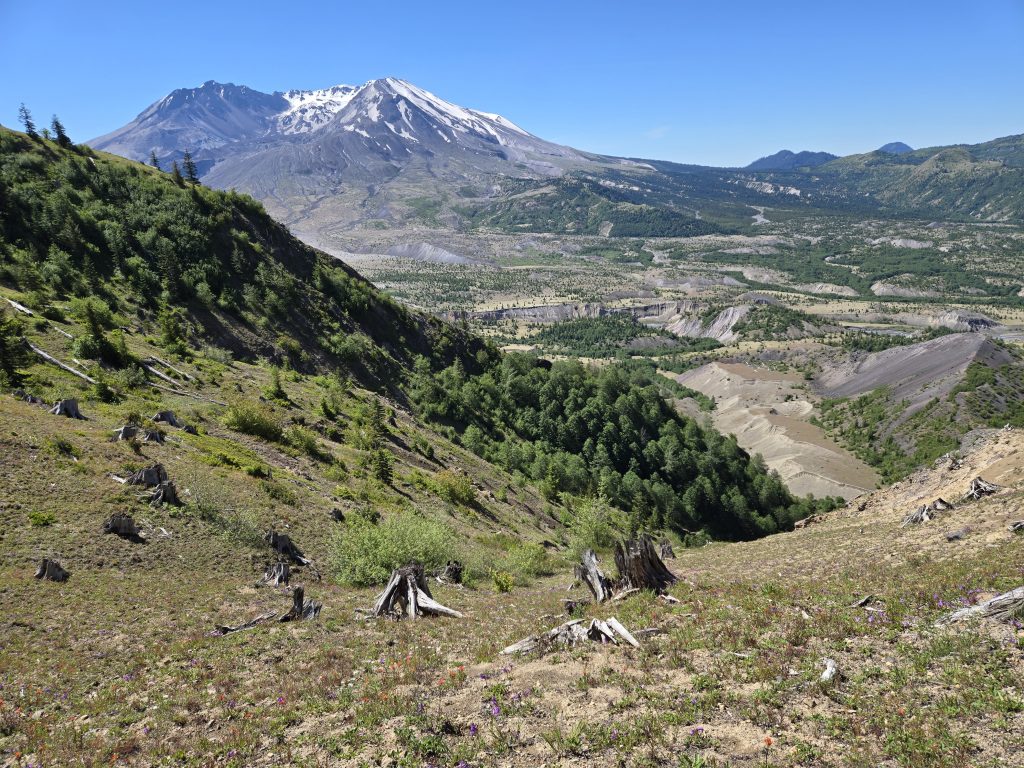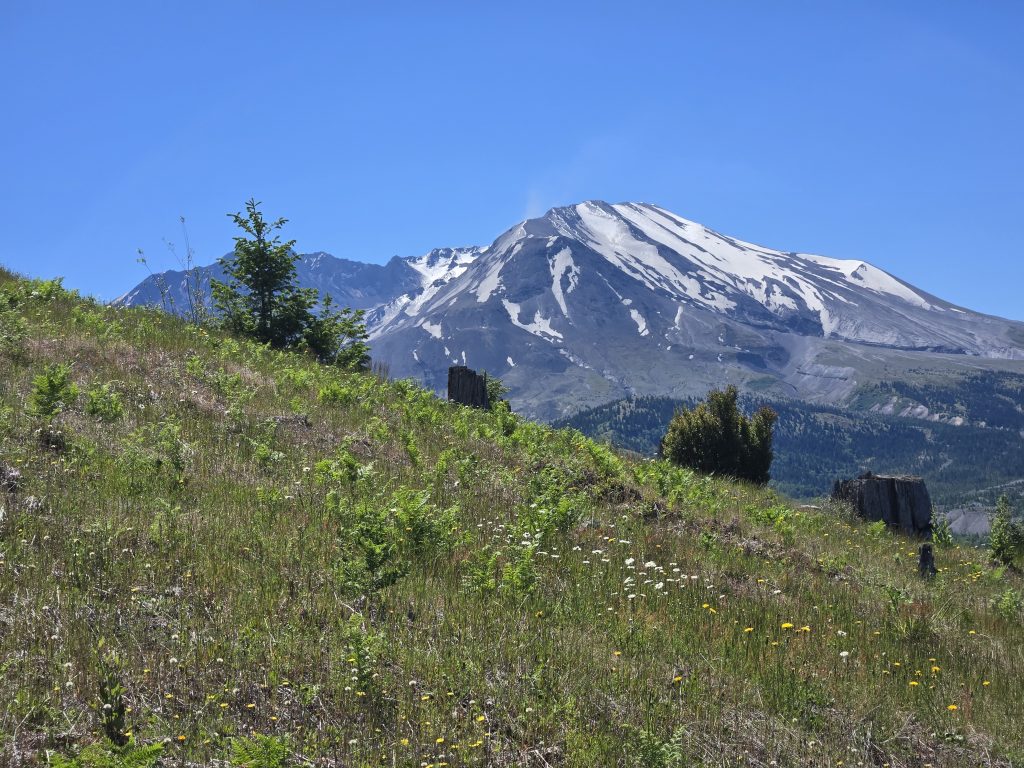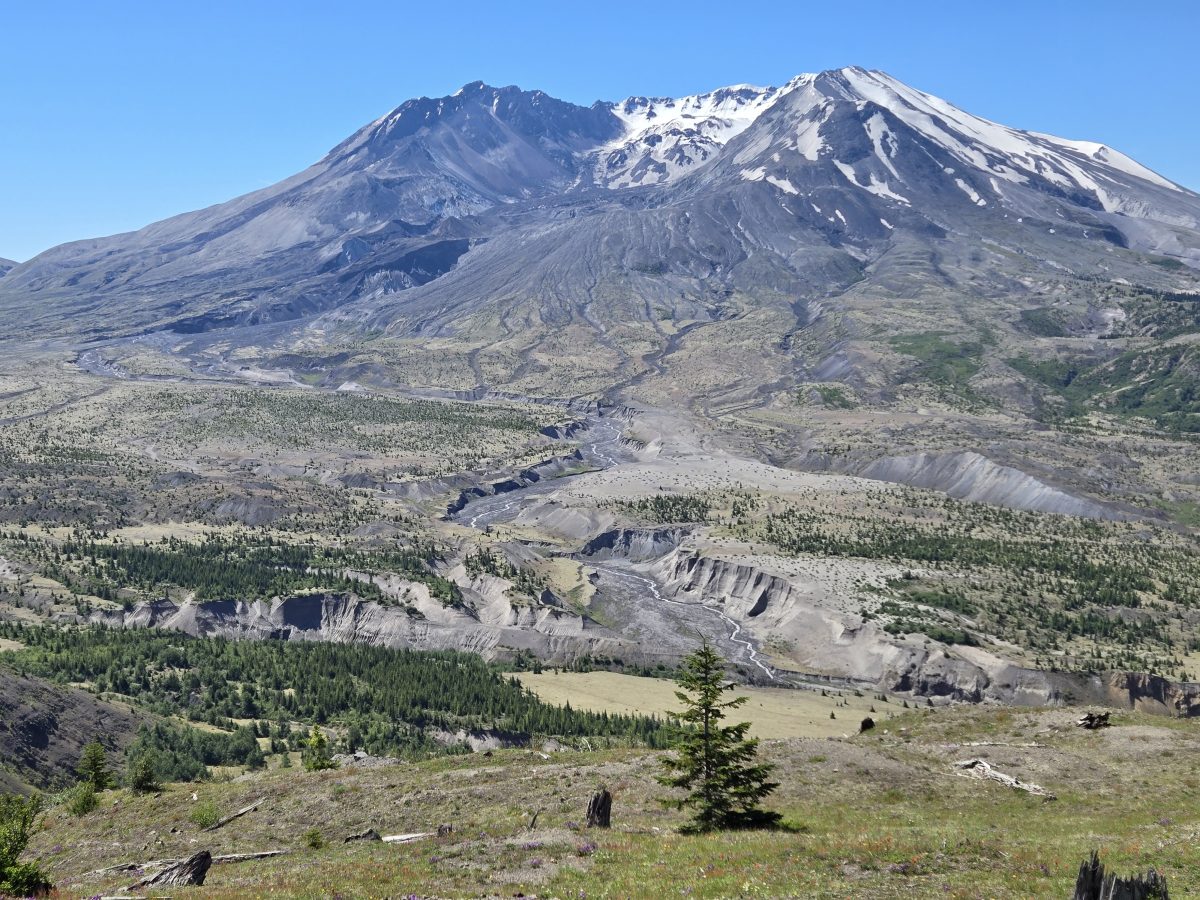
For all of our endeavors, both guided and misguided, to experience nature’s bounties for recreation and sustenance or to exploit it for extraction and subjugation, I am certain the earth, were it sentient, would see us as mere trifles. We have been remarkably proficient at destruction – leveling mountains, diverting rivers, draining lakes, acidifying oceans, changing the very climate around us. But our self-defeating aptitude for natural violence pales in comparison to what the earth itself can unleash. The Anthropocene era is an unprecedented attack on the world around us and the life it sustains but it is nothing like the events of the geological past where the earth has remade itself and its inhabitants many times over. This, dear readers, is what I pondered as I gazed upon Mount St. Helens, with its north face completely destroyed in an eruption that happened within living memory.
First, allow me a brief digression into the human experience, apropos really of nothing related to Mount St. Helens. One of the greatest mysteries of our existence is what goes through other peoples’ minds: how do they experience the world around them, why do they think the way they do. With our friends and our families and acquaintances we can for the most part have some concept of their lived experiences as we share similar customs and languages and environments.
Then there is the vast majority of the human race whose day-to-day existence is difficult to conceive. Of course we all have common emotions and physical needs – I’ve always chuckled at the possibly apocryphal tale that Napoleon had hemorrhoids at Waterloo (no matter how great a person you supposedly are, you still need to sleep and eat and shit) – that allow us to connect on some level but the differences in people can be so stark, especially when it comes to what we are thinking. This can be both a wonderful thing, representative of the diversity of our kind, but also an awful thing that polarizes our politics and leads to war and violence.
Then there is just the curious, the why-would-anyone-do-that. Consider the man in the parking lot outside of my motel in Kelso, Washington. I discovered this bear of a man, shirtless, standing motionless, starting at his phone, blasting some awful din that I am sure he considered music. In the moment, it wouldn’t be so odd as maybe he was having a smoke. But there he was in the same place, listening to same music, 30 minutes later, an hour later, still there as the night wore on. Stoned or drunk perhaps, but I couldn’t help wondering: what was he doing there and why? What was going through his mind? What is his system of logic, his thought process, that led him to this Motel 6 parking lot in the middle of nowhere, deciding to listen to his phone and its tinny speakers in what was a sweltering night.
It’s an uninteresting vignette to read about, I know, but I had also just read an essay on human consciousness and whether AI will achieve general intelligence. (I had also just finished watching Turkey lose a World Cup game so I needed to turn my attention elsewhere to cope). I am no expert on the philosophy of consciousness but I can’t help but thinking that we are so different in our minds from each other that the idea of AI emulating humans seems laughable. Maybe we are using the wrong paradigm. Maybe AI will achieve a sort of super intelligence but our mistake may be thinking of it in terms of human intelligence instead of a separate kind altogether. In any case, the man was no longer there in the morning, as I departed that forlorn side-of-the-highway motel for an hour’s drive toward the most recently erupted volcano in the United States.
The Cowlitz Indian people call Mount St. Helens La-we-lat-klah, meaning “Smoker,” and tell the story of how Coyote created her and Tahoma (Mount Rainier), followed by Patu (Mount Adams) to be the husband of the two. La-we-lat-klah grew jealous of Tahoma, threw fire at her and burned her head, shoulders and backbone. So the next time you are watching Summer House or Real Housewives or some other such show with their entertaining petty rivalries and revenges, keep in mind that they are nothing against the jealousies of a mountain.
I hiked an approximately ten mile out-and-back trail that led up to the Johnstone Observatory with wonderful views of Mount St. Helens all throughout. The road to the observatory was closed due to a landslide (another one of those casual acts of destruction by the earth), which meant I had the observatory almost entirely to myself. The hike itself was not particularly memorable as it wound through meadows dotted with wildflowers, their reds, and violets, and yellows peeking through the brush, perhaps a week or two before peak bloom but lovely nevertheless. I saw landscapes of jagged tree trunks, their desolation a poignant reminder of the fragility of the moment, still broken almost five decades on, unlikely to grow again in our lifetimes. But mostly it was nonstop incline in exposed sun that consumed most of my waking mind and energy.
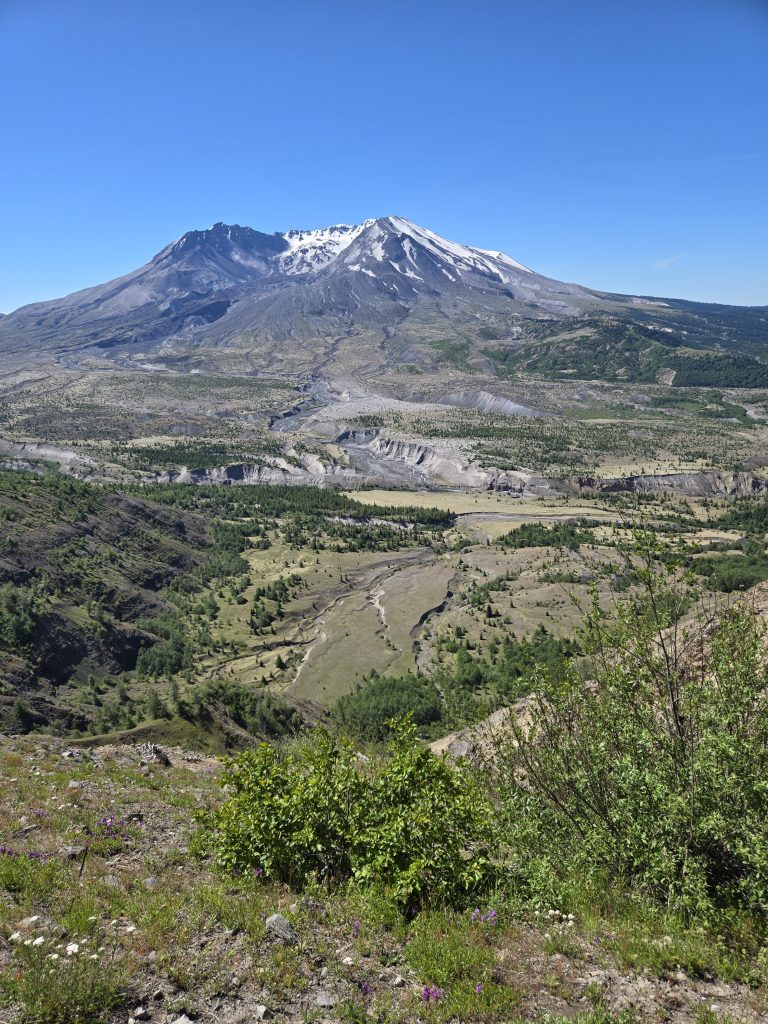
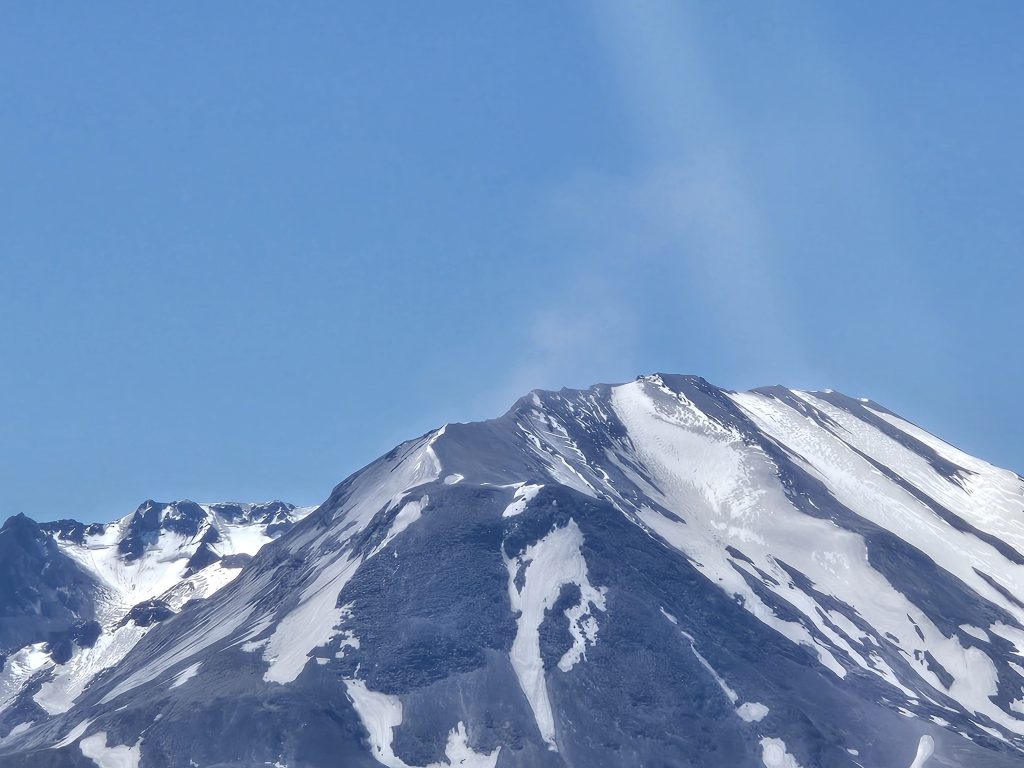
What elevated the trail, and made the effort worthwhile, was the constant presence of the mountain and in particular the collapsed north side. I have already spoken at length on the mysticism and allure of “The Mountain” so it is particularly moving to see one with much of its top destroyed by its own devices. And it is a bit disconcerting, if you let the moment affect you, to be in the shadow of a volcano and wonder when it will next erupt (I spied some wisps arising from its crater but apparently that is very common). As an aside, all of the mountains in the Cascades are active volcanoes, an idea that boggles the mind of a placid east coast dweller with our ancient Appalachians, who entered their dotage long ago.
The landscape around the mountain began to regenerate soon after the eruption but the process is slow. But it is steady and it is happening. Our presence is likely hampering the progress but this is the opposite side of of nature’s destruction: after the fire and the violence there are new ecosystems, new life, new stories. Our ego is such that we think we can conquer the world we live in. Perhaps one day, in a science fiction future, we truly can understand and mold the world, but for now we are not its masters but simply temporary residents whose time will pass. While some may find despair in our existential smallness, I find it exhilarating. How fortunate are we to be alive. Life is good because life is precious!