We tend to describe and debate the spirit of a place by its character, its energy, using ephemeral concepts of culture or people or manmade institutions. DC is defined by being the seat of government for the most powerful nation in the world, New York by its vibrancy and its diversity and its financial prowess, Los Angeles by celebrity and glamour. These are of course very general descriptors that do little justice to the complexity of these vast cities and each requires volumes of books to truly describe them. Nonfiction, yes, though fiction also does quite well. A few years ago I read a duology by the speculative fiction writer NK Jemison, where she imagined that cities had avatars that represented them (her story was about New York, in which case each borough had its own avatar as well). Part of her theme was that cities and places change their character, and so too do the avatars in her telling, as the people and cultures evolve through time. The DC of today, for example, with the subtle but irrepressible influence of data centers, is different from the DC that I first moved to less than two decades ago.
It seems we rarely describe or define places by their environment anymore and perhaps that is because we have done so much to alter and suppress those environments. This may be an east-coast bias (where the entire coast seems to be on its way to becoming a single urban agglomeration, similar to William Gibson’s Sprawl). You see some hints of it; for example, DC was literally a swamp before it took on the word as a metaphorical nickname. But then there is the West, where things are a bit different because everything is bigger. The mountains rise higher, the rivers are wider, the lakes more voluminous. Here, it is not just the culture that provides energy to a place but the natural surroundings. As I drove along the Columbia River gorge towards the small city of Hood River in Oregon, I pondered this as Mount Hood loomed ever larger on the horizon. What is it like living so near such a large mountain and an active volcano at that?
In Hood River, I stayed with my friend Jesse and my new friends Kat and Eddie (their dog). I was overwhelmed by their kindness and hospitality. Knowing my love of soccer, they had turned on a World Cup game in the guest room to welcome me. While I will never get tired of solitude in nature, there are few, if really any, experiences better in our short time in this world than good company with good people.


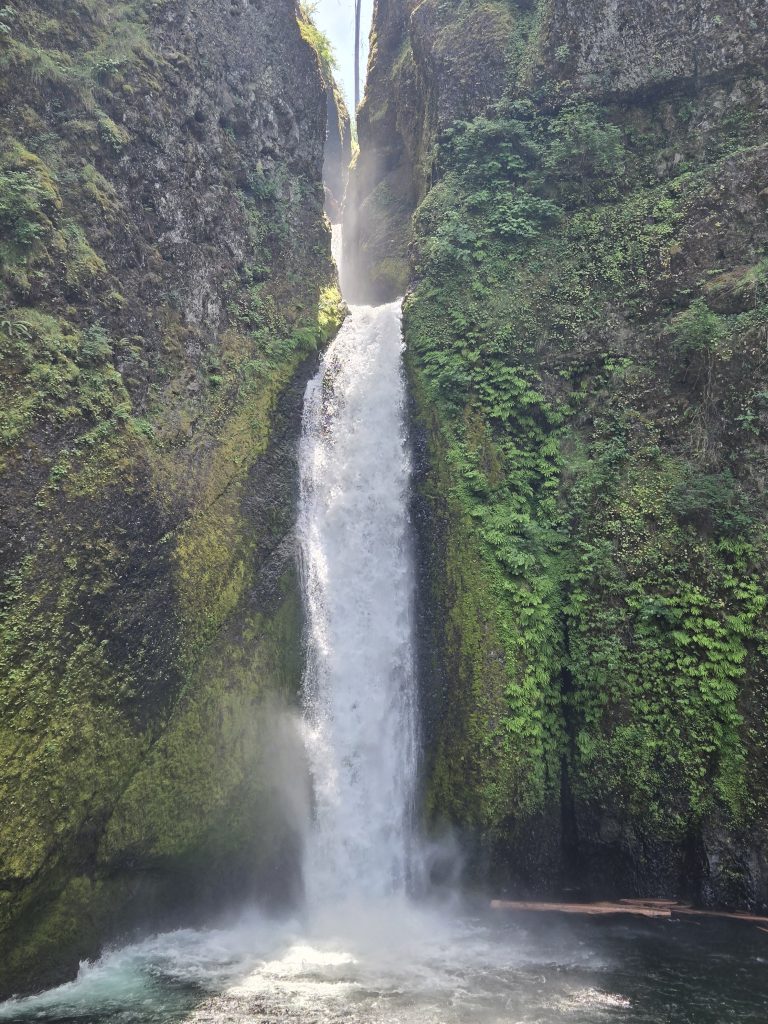
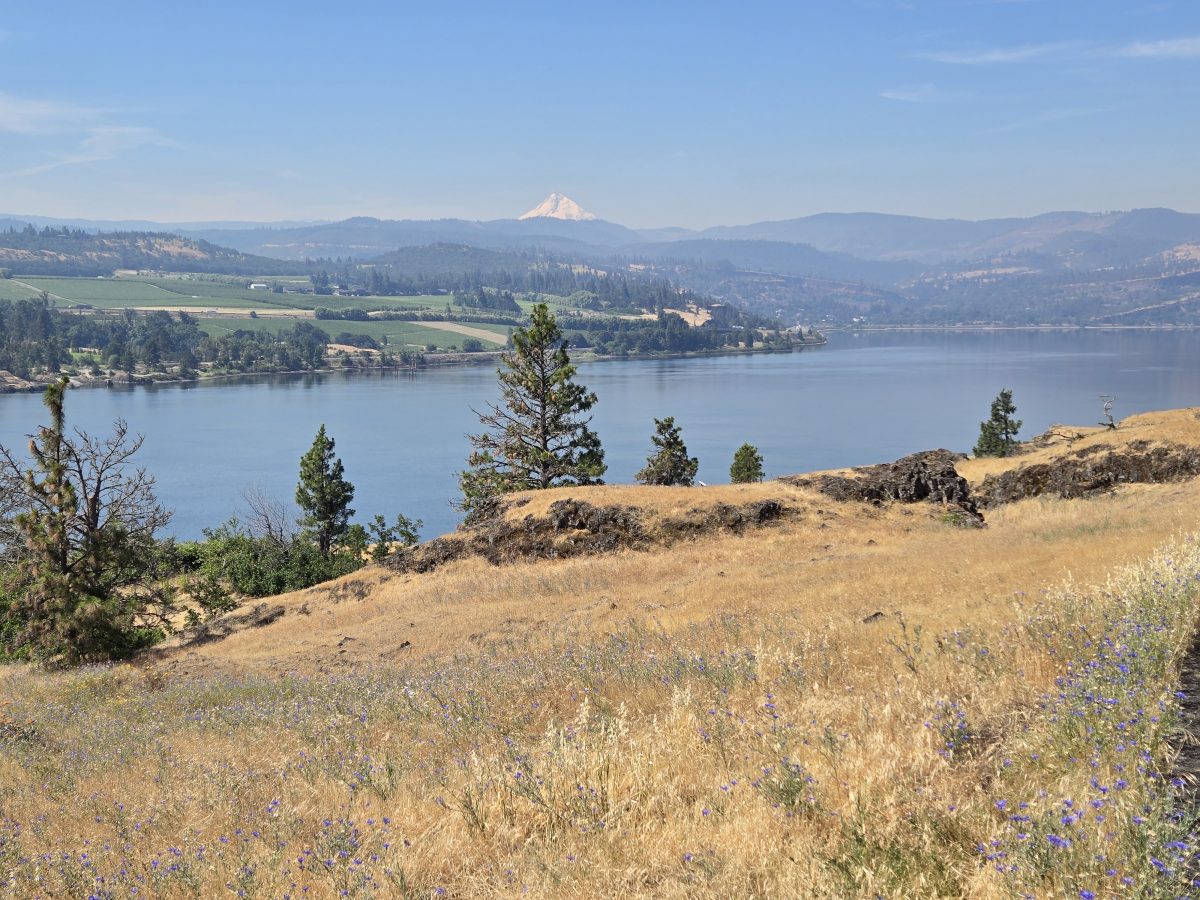
I’d been to Hood River before so I took it a little bit easier with just two short hikes, one on the Washington side of the gorge that took me up a small peak with lovely views of Mount Hood across the river and the came back down through a small forest, redolent with scent of conifers and teeming with wildflowers. My second hike, more of a stroll, was to a waterfall, which I felt like I must do despite my apathy of waterfalls – it is after all the Columbia Gorge with its waterfall alley. It was a nice waterfall if you are a local, especially a youth whose school just ended, as it has a decent sized pond at its base. Most people arrived ready for swimming. I arrived in full-on hiking gear, carrying a large pack. I’m sure this is one of those times where others were pondering me, what is this guy thinking, sheesh, if of course they even clocked my presence.
Of more note, I enjoyed several good meals, including sturgeon, which apparently resides in the Columbia River (and not just the Caspian Sea) and several good conversations. We did eventually get to the topic of what it’s like to live in the shadow of a large mountain. In the case of Hood River, there are really two: the city is in the piedmont of Mount Hood but Mount Adams in Washington across the river is also omnipresent. Step outside of Jesse and Kat’s home, look one way you see Mount Hood, look the other, you see Mount Adams. One concept that resonated with me is the sense of direction and structure it gives a person. You always know where you are because you always know where the two mountains are. That is a completely foreign experience to the DC area, where maybe you can see the Shenandoah mountains in the distance but there is very little relationship to your day to day. However subtle or subconscious, there is a different energy because of the mountains.
After a day and a half in Hood River, I embarked on my longest drive of the trip, one that traversed the entire state of Oregon, starting alongside the banks of the Columbia River, paralleled the Cascades as far as Mt Mazama and Crater Lake, then cut southwest to eventually end the day in Eureka, California.