Categories
travel

A Journey to the West: Part Seven

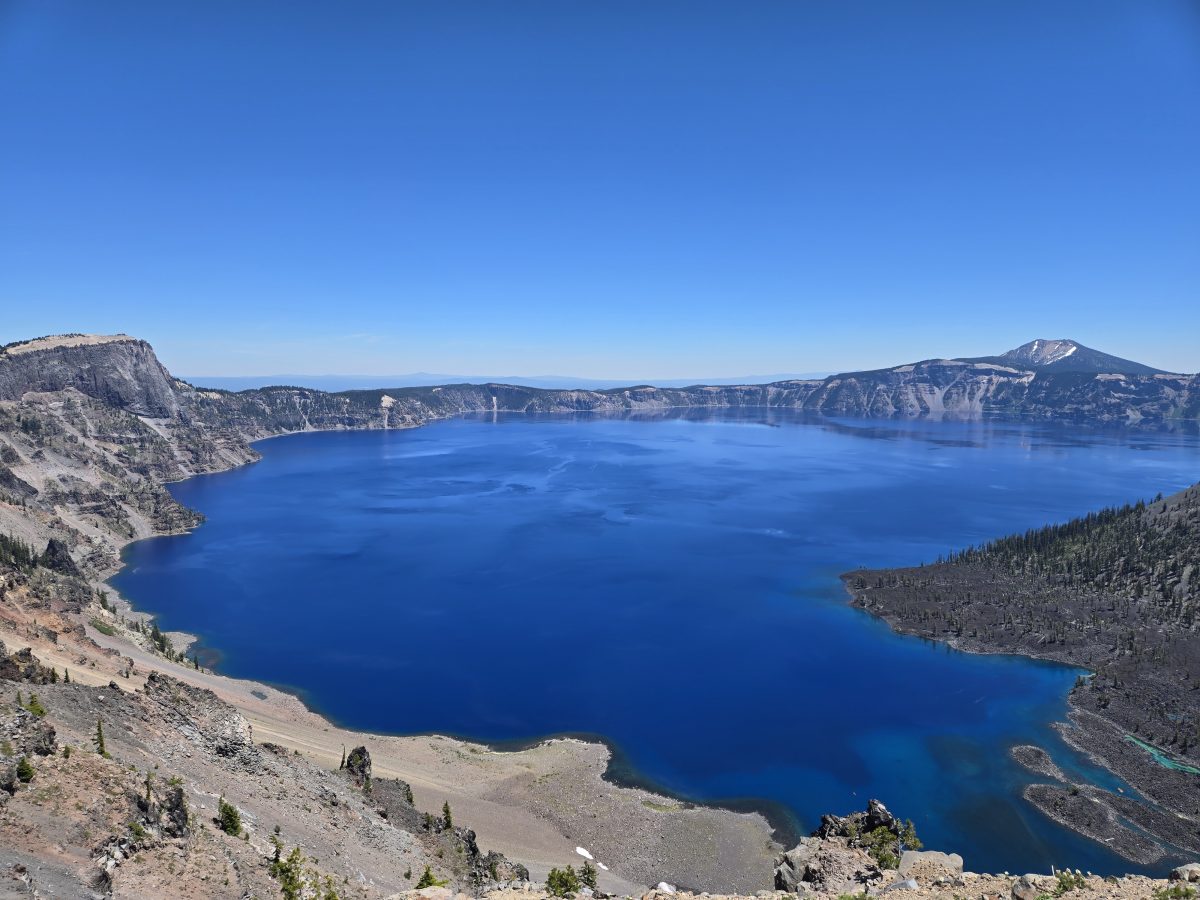
In the 1850s, a gold prospector named John Wesley Hilton and others “discovered” Crater Lake while searching for a lost mine. Hilton said: “I knew when I gazed upon Crater Lake that even though the west was filled with undiscovered wonders, Crater Lake would hold its own.” What seems like in some ways nothing so special as it is after all just a lake is in reality an awe-inspiring wonder in both its geological history and its unique beauty. When trying to describe it to some fellow travelers later the same day in California, the first comparison that sprung to mind was the Grand Canyon. It is one of those places where pictures, no matter how beautiful they come out, cannot do it justice. I overheard a child provide the perfect description: “The water looks fake.” It does look fake because there is a sense of unreality, a can-it-really-be-this-blue that just hits differently in person.

First, a quick geological overview: Mount Mazama was originally a 12,000 foot peak in the Cascades before a massive eruption over 6000 years ago removed nearly four thousand feet from its height and created a caldera that would form the bed of Crater Lake. Over 20 square miles in surface area and with a maximum depth of nearly 2000 feet, Crater Lake is the deepest freshwater lake in North America. Oh, and it just happens to be on the top of a mountain that despite the eruption is still 8000 feet above sea level.

My drive there from Hood River was over three hours but hardly tiring because of how lovely it was. Much of the first hour was spent circumventing the slopes of Mount Hood as the highway wound through heavy forests and beautiful farms preparing for the first cull of cherries. I then emerged into the high desert of Oregon, driving south with the Cascades a constant companion to my right. The peaks were not as prominent as Rainier and Adams and Hood but still dominated the horizon, each distinct and separate from the range, a dream landscape for a painter.

The final stretch was billed as a “scenic” highway but the 20 miles were really nothing special compared to the rest of the drive as the surroundings were mostly barren and insects hovered incessantly about my windshield. Perhaps I am being overdramatic or even mystical, but on entering the park itself the atmosphere changed. It was still another ten miles but each minute my anticipation grew as I noticed I had unconsciously slowed down to extend the moment. Just a different feeling in the air.

It is difficult to describe the moment I saw the lake as I pulled over to the first overlook. Of course I had seen pictures but nothing prepares you for how blue the lake is. I have been fortunate to have seen so many beautiful shades of blue and green and turquoise across the world but the color of Crater Lake makes no sense. I will be shaking my head at its memory for years to come. I also discovered those hovering insects were actually lovely butterflies, less hovering and more fluttering, a wonderful complement to the serene and magical environment.

Unfortunately part of the rim drive was still closed due to the season, while the pathway down to the lake has been under rehabilitation for a couple of years so my experience was limited to views from the rim. Still, I spent more time there than expected, stopping at every overlook (which was the same thing I did at the Grand Canyon a few years ago – yes, it’s the same lake, and not nearly as massive as the canyon, but somehow a slightly different angle provided a completely different perspective), which meant I ran into the same people regularly and earned the moniker “Virginia,” which admittedly is not as striking as my actual nom de guerre “Hollywood,” but endearing nonetheless.

I was taken aback at one of the overlooks as a couple of Buddhist monks ignored the do not step off the path sign to step off the path for a better picture but I suppose all life is indeed suffering, including for fragile wildflower ecosystems. I did wonder where they came from and why, as there is something charmingly jarring about monks driving a rental car and angling for photo opportunities. I ended my time there contentedly noshing on a sandwich with smoked Chinook salmon from a fish market in Hood River, gazing at the lake for a final time and mentally adding a to-do to return one day so I could enter its waters. 

But the day was still young and much more driving was in the cards as my next destination was another of those you-must-see-them-to-believe-them wonders of the world: the majestic Redwoods of Northern California. 

Categories
travel

A Journey to the West: Part Six

We tend to describe and debate the spirit of a place by its character, its energy, using ephemeral concepts of culture or people or manmade institutions. DC is defined by being the seat of government for the most powerful nation in the world, New York by its vibrancy and its diversity and its financial prowess, Los Angeles by celebrity and glamour. These are of course very general descriptors that do little justice to the complexity of these vast cities and each requires volumes of books to truly describe them. Nonfiction, yes, though fiction also does quite well. A few years ago I read a duology by the speculative fiction writer NK Jemison, where she imagined that cities had avatars that represented them (her story was about New York, in which case each borough had its own avatar as well). Part of her theme was that cities and places change their character, and so too do the avatars in her telling, as the people and cultures evolve through time. The DC of today, for example, with the subtle but irrepressible influence of data centers, is different from the DC that I first moved to less than two decades ago. 

It seems we rarely describe or define places by their environment anymore and perhaps that is because we have done so much to alter and suppress those environments. This may be an east-coast bias (where the entire coast seems to be on its way to becoming a single urban agglomeration, similar to William Gibson’s Sprawl). You see some hints of it; for example, DC was literally a swamp before it took on the word as a metaphorical nickname. But then there is the West, where things are a bit different because everything is bigger. The mountains rise higher, the rivers are wider, the lakes more voluminous. Here, it is not just the culture that provides energy to a place but the natural surroundings.  As I drove along the Columbia River gorge towards the small city of Hood River in Oregon, I pondered this as Mount Hood loomed ever larger on the horizon. What is it like living so near such a large mountain and an active volcano at that?

In Hood River, I stayed with my friend Jesse and my new friends Kat and Eddie (their dog). I was overwhelmed by their kindness and hospitality. Knowing my love of soccer, they had turned on a World Cup game in the guest room to welcome me. While I will never get tired of solitude in nature, there are few, if really any, experiences better in our short time in this world than good company with good people.

Trash pickup day in the neighborhood with Mount Adams looming in the distance

Eddie, who is just an amazing sleeper

I’d been to Hood River before so I took it a little bit easier with just two short hikes, one on the Washington side of the gorge that took me up a small peak with lovely views of Mount Hood across the river and the came back down through a small forest, redolent with scent of conifers and teeming with wildflowers. My second hike, more of a stroll, was to a waterfall, which I felt like I must do despite my apathy of waterfalls – it is after all the Columbia Gorge with its waterfall alley. It was a nice waterfall if you are a local, especially a youth whose school just ended, as it has a decent sized pond at its base. Most people arrived ready for swimming. I arrived in full-on hiking gear, carrying a large pack. I’m sure this is one of those times where others were pondering me, what is this guy thinking, sheesh, if of course they even clocked my presence. 

Of more note, I enjoyed several good meals, including sturgeon, which apparently resides in the Columbia River (and not just the Caspian Sea) and several good conversations. We did eventually get to the topic of what it’s like to live in the shadow of a large mountain. In the case of Hood River, there are really two: the city is in the piedmont of Mount Hood but Mount Adams in Washington across the river is also omnipresent. Step outside of Jesse and Kat’s home, look one way you see Mount Hood, look the other, you see Mount Adams. One concept that resonated with me is the sense of direction and structure it gives a person. You always know where you are because you always know where the two mountains are. That is a completely foreign experience to the DC area, where maybe you can see the Shenandoah mountains in the distance but there is very little relationship to your day to day. However subtle or subconscious, there is a different energy because of the mountains. 

After a day and a half in Hood River, I embarked on my longest drive of the trip, one that traversed the entire state of Oregon, starting alongside the banks of the Columbia River, paralleled the Cascades as far as Mt Mazama and Crater Lake, then cut southwest to eventually end the day in Eureka, California.

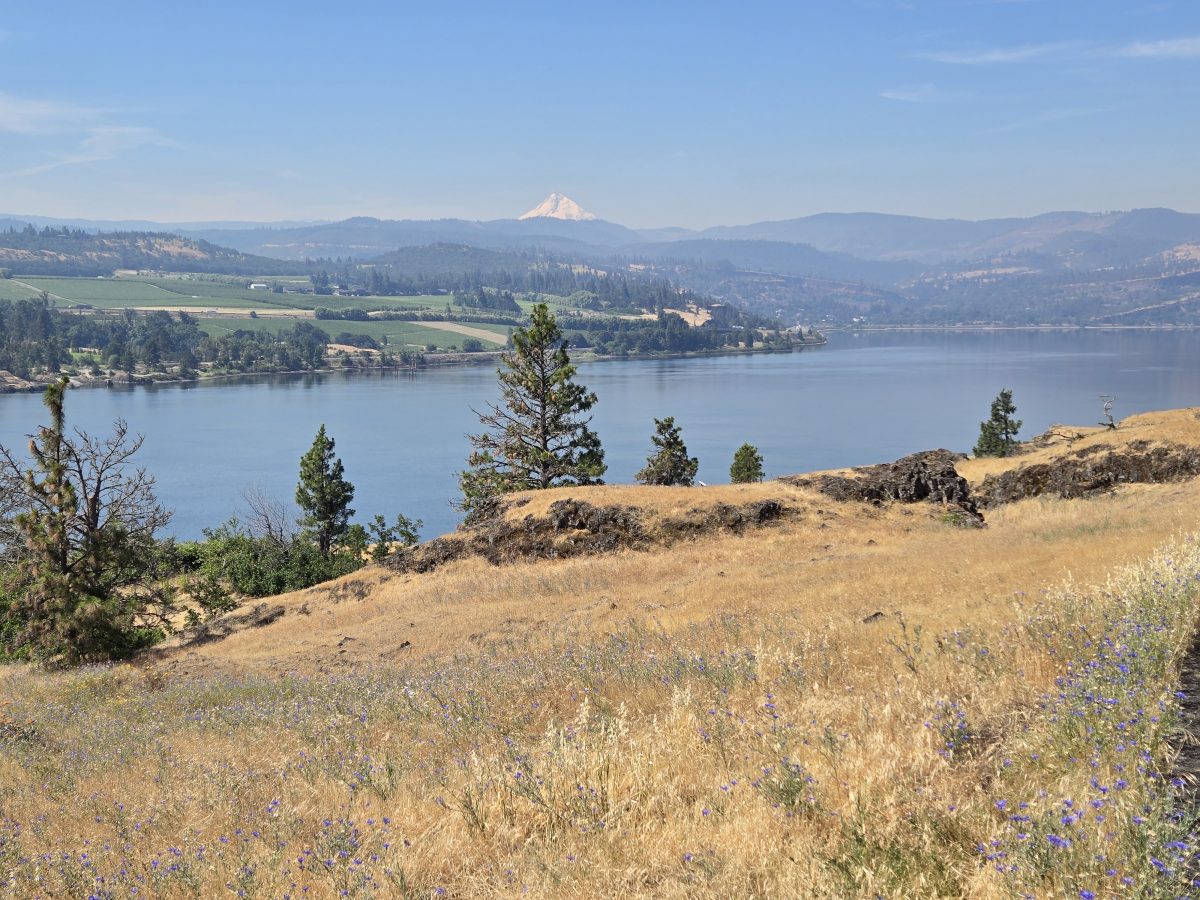
Mount Hood across the Columbia River gorge
Mount Hood and wildflowers at Catherine Creek in Washington
Wahclella Falls in Oregon
Categories
travel

A Journey to the West: Part Five

For all of our endeavors, both guided and misguided, to experience nature’s bounties for recreation and sustenance or to exploit it for extraction and subjugation, I am certain the earth, were it sentient, would see us as mere trifles. We have been remarkably proficient at destruction – leveling mountains, diverting rivers, draining lakes, acidifying oceans, changing the very climate around us. But our self-defeating aptitude for natural violence  pales in comparison to what the earth itself can unleash. The Anthropocene era is an unprecedented attack on the world around us and the life it sustains but it is nothing like the events of the geological past where the earth has remade itself and its inhabitants many times over. This, dear readers, is what I pondered as I gazed upon Mount St. Helens, with its north face completely destroyed in an eruption that happened within living memory.

First, allow me a brief digression into the human experience, apropos really of nothing related to Mount St. Helens. One of the greatest mysteries of our existence is what goes through other peoples’ minds: how do they experience the world around them, why do they think the way they do. With our friends and our families and acquaintances we can for the most part have some concept of their lived experiences as we share similar customs and languages and environments.

Then there is the vast majority of the human race whose day-to-day existence is difficult to conceive. Of course we all have common emotions and physical needs – I’ve always chuckled at the possibly apocryphal tale that Napoleon had hemorrhoids at Waterloo (no matter how great a person you supposedly are, you still need to sleep and eat and shit) – that allow us to connect on some level but the differences in people can be so stark, especially when it comes to what we are thinking. This can be both a wonderful thing, representative of the diversity of our kind, but also an awful thing that polarizes our politics and leads to war and violence.

Then there is just the curious, the why-would-anyone-do-that. Consider the man in the parking lot outside of my motel in Kelso, Washington. I discovered this bear of a man, shirtless, standing motionless, starting at his phone, blasting some awful din that I am sure he considered music. In the moment, it wouldn’t be so odd as maybe he was having a smoke. But there he was in the same place, listening to same music, 30 minutes later, an hour later, still there as the night wore on. Stoned or drunk perhaps, but I couldn’t help wondering: what was he doing there and why? What was going through his mind? What is his system of logic, his thought process, that led him to this Motel 6 parking lot in the middle of nowhere, deciding to listen to his phone and its tinny speakers in what was a sweltering night.

It’s an uninteresting vignette to read about, I know, but I had also just read an essay on human consciousness and whether AI will achieve general intelligence. (I had also just finished watching Turkey lose a World Cup game so I needed to turn my attention elsewhere to cope). I am no expert on the philosophy of consciousness but I can’t help but thinking that we are so different in our minds from each other that the idea of AI emulating humans seems laughable. Maybe we are using the wrong paradigm. Maybe AI will achieve a sort of super intelligence but our mistake may be thinking of it in terms of human intelligence instead of a separate kind altogether. In any case, the man was no longer there in the morning, as I departed that forlorn side-of-the-highway motel for an hour’s drive toward the most recently erupted volcano in the United States.

The Cowlitz Indian people call Mount St. Helens La-we-lat-klah, meaning “Smoker,” and tell the story of how Coyote created her and Tahoma (Mount Rainier), followed by Patu (Mount Adams) to be the husband of the two. La-we-lat-klah grew jealous of Tahoma, threw fire at her and burned her head, shoulders and backbone. So the next time you are watching Summer House or Real Housewives or some other such show with their entertaining petty rivalries and revenges, keep in mind that they are nothing against the jealousies of a mountain.

I hiked an approximately ten mile out-and-back trail that led up to the Johnstone Observatory with wonderful views of Mount St. Helens all throughout. The road to the observatory was closed due to a landslide (another one of those casual acts of destruction by the earth), which meant I had the observatory almost entirely to myself. The hike itself was not particularly memorable as it wound through meadows dotted with wildflowers, their reds, and violets, and yellows peeking through the brush, perhaps a week or two before peak bloom but lovely nevertheless. I saw landscapes of jagged tree trunks, their desolation a poignant reminder of the fragility of the moment, still broken almost five decades on, unlikely to grow again in our lifetimes. But mostly it was nonstop incline in exposed sun that consumed most of my waking mind and energy.

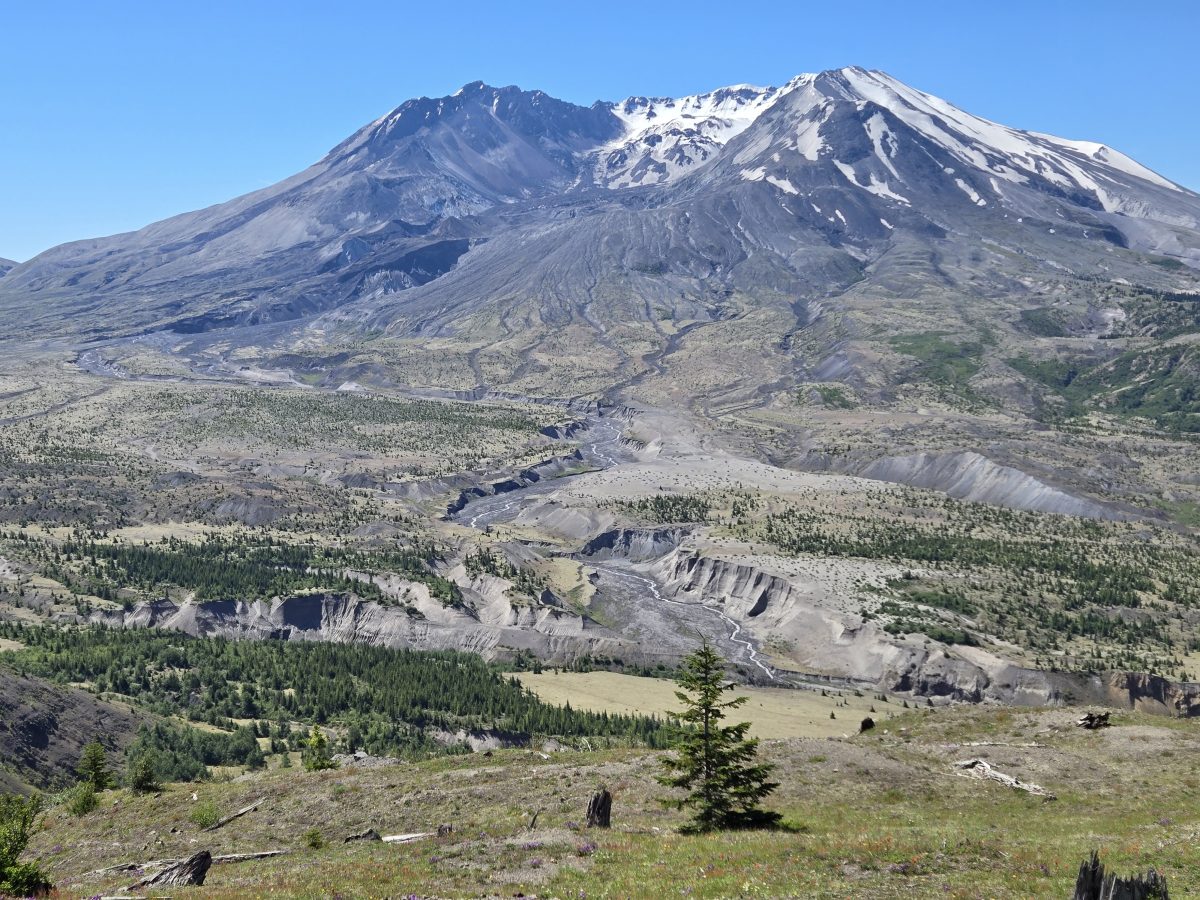
What elevated the trail, and made the effort worthwhile, was the constant presence of the mountain and in particular the collapsed north side. I have already spoken at length on the mysticism and allure of “The Mountain” so it is particularly moving to see one with much of its top destroyed by its own devices. And it is a bit disconcerting, if you let the moment affect you, to be in the shadow of a volcano and wonder when it will next erupt (I spied some wisps arising from its crater but apparently that is very common). As an aside, all of the mountains in the Cascades are active volcanoes, an idea that boggles the mind of a placid east coast dweller with our ancient Appalachians, who entered their dotage long ago.

The landscape around the mountain began to regenerate soon after the eruption but the process is slow. But it is steady and it is happening. Our presence is likely hampering the progress but this is the opposite side of of nature’s destruction: after the fire and the violence there are new ecosystems, new life, new stories. Our ego is such that we think we can conquer the world we live in. Perhaps one day, in a science fiction future, we truly can understand and mold the world, but for now we are not its masters but simply temporary residents whose time will pass. While some may find despair in our existential smallness, I find it exhilarating. How fortunate are we to be alive. Life is good because life is precious!

Categories
travel

A Journey to the West: Part Four

The mountain. Surely there are few more awesome elements of our natural world, surpassed perhaps only by the seas and their boundless,unfathomable depths. The mountain is awesome in its original meaning, generating awe at its grandeur, wonder at its existence. Birthed by titanic and tectonic forces, the mountain not only rises to pierce the clouds and the skies but grows outwards to create a landscape unto itself. While the inexorable rhythms of wind and water may whittle its heights and its heart, the mountain even to this day resists human efforts to create pathways through it. Those great tunnels that carve through a mountain are feats of engineering but barely a dent in its side and the roads we create must weave and wind along its slopes as nature allows – not as we would wish to dictate. There is a reason the phrase moving mountains has its meaning: it is an impossible task.

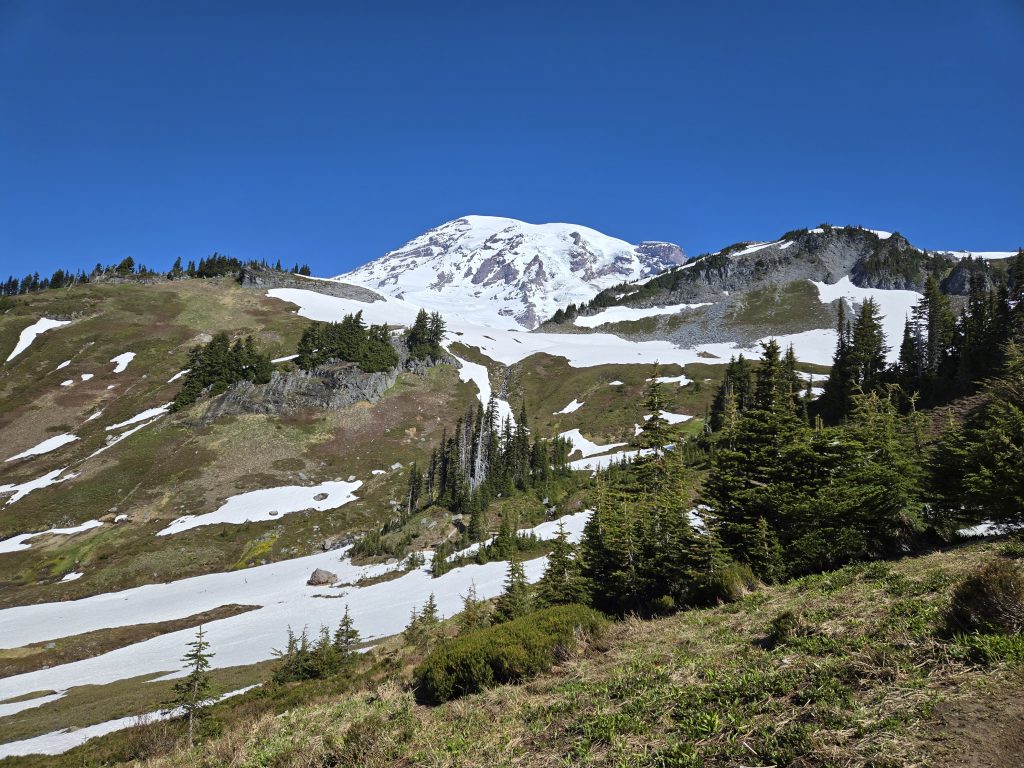
I speak of the mountain, not the mountain range. The mountain is the one that rises above its siblings to dominate the vista, creating a view seemingly painted by nature, inspiring artists and stories and legends across all cultures under its gaze. Mount Rainier, called many names by many peoples, is such a mountain. It is an inescapable and majestic presence, visible for miles and miles, housing towns and villages on its slopes, and home to one of the great national parks of the country.

It is also home to one of the great hikes that the US has to offer: the Skyline Trail. It doesn’t have the name recognition of other classics like Angel’s Landing or Half-Dome but it is probably the most fun hike I have ever done. I have a feeling I did it at just the right time as well. I am sure the trail is beyond gorgeous in July when all the snow has melted and the wildflowers are in peak bloom. But in mid-June much of the trail was still covered in snow while in the lower reaches the alpine meadow was emerging and the marmots were about.

The beginning of the hike was crowded as the slow ascent included expert hikers with their microspikes and trekking poles, amateur but experienced hikers like myself hoping their boots would provide the necessary traction, most people in sneakers, some in shorts and a tshirt, others bundled for cold winds of the highest points of the hike. My favorite getups, the ones that had me scratching my head, included the man in tshirt, shorts, and sneakers, carrying a child in one of those carriers that you see babies in, but in this case the child was definitely a toddler capable of carrying on a conversation (it was in Chinese so unfortunately I was unable to effectively eavesdrop. On the way down, I saw a young woman in a tshirt and sweatpants, carrying only a single water bottle, and comfortably scaling the snow in… Crocs. Oh humanity, you never cease to amaze.

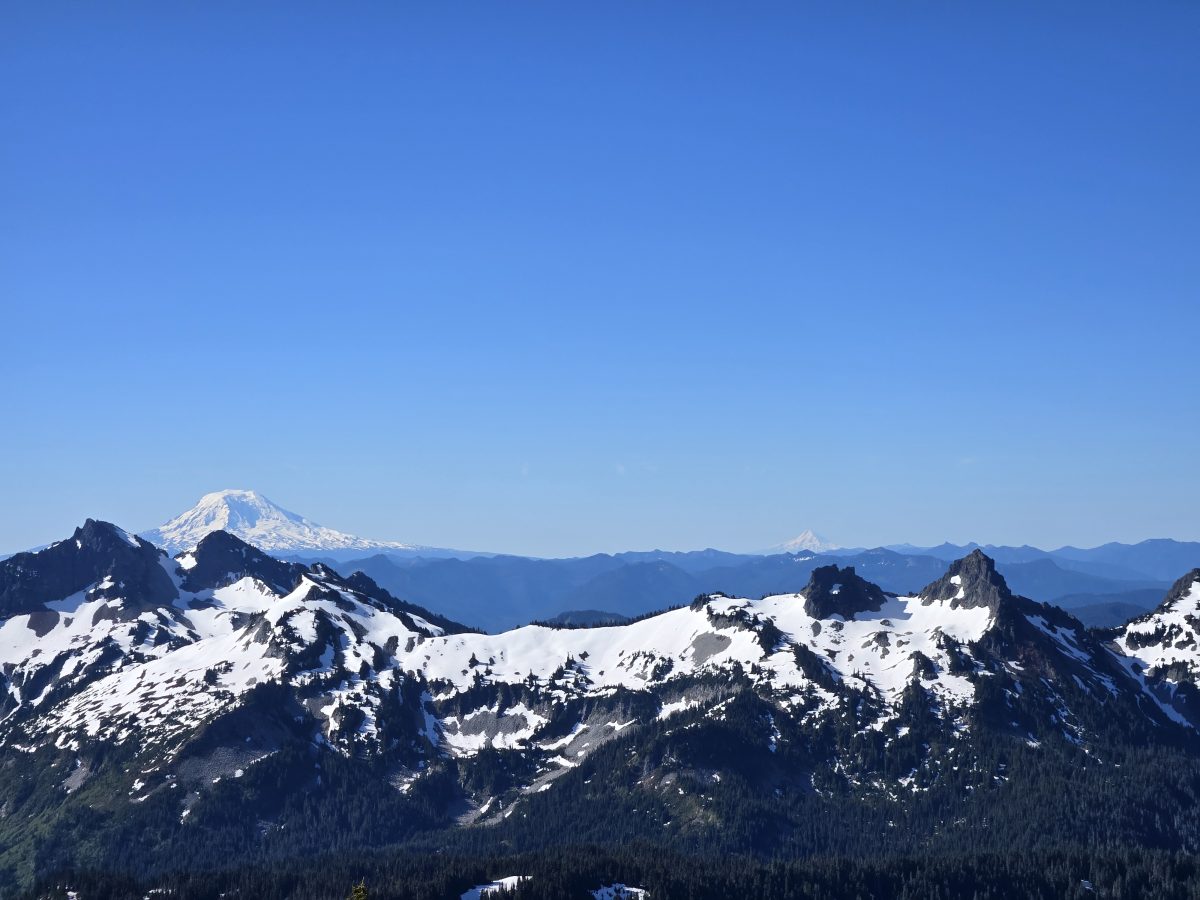
The crowds started to thin out at the first major slop covered in snow. The snow was firm and slushy, technically similar to dusty and rocky slopes, where every step up had a bit of a slip and a bit of a slide. In this case, I benefited from the previous hikers of the last couple of days as their footprints had solidified into foot holds. Every part of the trail was fun, from figuring out trickier ascents in the snow to deciding on some descents to just get on my ass and slide down. The trail’s main scenic payoff is Panorama Point, with a clear view of the Cascades, with each of Mt Adams, Mt Hood, and Mt St Helens visible to the naked eye in the distance. Nearly 7000 feet high, the peak of Mt Rainier from this point looms large, giving the false impression that you are nearly there before realizing, no, it’s actually another 7000 feet to the top.

I took a short cut on the way down, heeding the cautions of the park rangers to avoid the easternmost stretch of the loop due to hazardous conditions. There was enough snow that some people were bypassing the trail altogether by human sledding down a couple of slopes while those working their way up in the opposition direction lost the trail as some misguided footprints compounded as more people overshot a turn. It was a bit amusing when going down to have someone randomly pop out from behind a switchback or small hill of snow to ask, courteously I should add, where in tarnation is the trail?

At the bottom, there is a waterfall. I took an obligatory photo for posterity before making my way to the visitor center, which unfortunately was temporarily closed as some moron had let loose some bear spray inside. Back to the lodge then, where I barely resisted the temptation for a second soft-serve ice cream in as many days. I don’t even know why they ask whether you want vanilla chocolate or twist. For soft-serve, there is only one answer: twist.

After lunch, I took an alternate route out of the park so my hopes of mountainside driving were dashed but the scenery made up for it. I’d like to say I took the curves like James Bond looking to impress a lady friend or chase a dastardly mega villain but age has mellowed me (like a fine whisky, of course) and experience has allowed me to overcome my white knuckles on the steering wheel style of the past. In any case, no road in a national park can be as terrifying as some I’ve crossed in Turkey, with two-and-fro traffic in a ledge barely enough for two cars, let alone the lorries that typically thunder on those mountain roads. 

I did one more hike on my way out after espying a parking spot, an unexpected fortune on a weekend afternoon. The Snow Lake trail seemed like a good digestif after the epic Skyline experience of the morning but ended up being fairly challenging as it kept going up and up and up for a mile and change in the beating afternoon sun, unrelenting evening the pleasant mountain spring weather that was slowly turning oppressively hot. Snow Lake itself was quite beautiful, exactly what you want of an alpine lake, serene and crystal clear.

Soon after I bid adieu to a beautiful day at a great national park and resumed my journey, heading south toward Mt St Helens, the jealous mountain.