Categories
travel

A Journey to the West: Part Three

I consider myself a fairly easy person, opinionated, yes, and perhaps prone to the odd fit of hangriness but generally willing to go with the flow and enjoying myself regardless. When visiting friends, I am just as much at peace joining them for a trip to Costco or Home Depot as I am going on an adventure. I will, however, admit that when it comes to some of the staples of the American diet, and particularly the American breakfast diet, I can be a touch precious. My aversion to cheese has become the stuff of legends and it seems that any savory breakfast offering in this country has cheese in it. I find coffee to be unappetizing and prefer the subtler and more elegant flavors of tea that my refined palate demands. And as a wise sage (not me) once remarked, bread is just a vehicle, and unfortunately our nation has a predilection to pile anything and everything that is cheesy into this vehicle and call it breakfast. 

Suffice it to say, I started an ultimately epic day with a despondently unepic breakfast, grumbling to myself at a drive-through coffee shop (Forks is not exactly a culinary center) and eventually ending up with a weak tea and a toasted everything bagel that was only diffidently toasted and certainly did not have much of anything, let alone everything, on it. My grumpiness only increased as I realized how many other people were heading towards my destination, my most anticipated stop in the Olympic National Forest, the Hoh Rainforest.

O ye of little faith, do not doubt the fates that look kindly upon you for they surely did on me. Yes, the parking lot was more crowded than I had hoped at the early hour but nothing could diminish the magic of this place. There were but two short hikes, better described as walks rather than hikes, but they unveiled a unique landscape, a journey to what seemed like prehistoric times. 

As most people inexplicably hemmed and hawed, and doodled and dawdled and so forth about their cars in the lot, I made my way to the first of the loops, the aptly named Hall of Mosses. Surprisingly few people were on the trail – thank you, fates – and all gazed about them in reverence while speaking in hushed tones. The solemnity of the environment was broken a few times by the car alarm of some ignoramus or another just to remind us that “civilization” was only a few meters away but this thankfully was over quickly. 

The days in the Pacific Northwest have been green – everywhere there is green, green, green. It is not the green of Ireland, which is bright and lush but generally manicured as trees are not in abundance on the Emerald Isle. In the PNW, and especially in the Hoh Rainforest, the green is also lush, but it is also majestic and huge. It can be bright, yes, but it spans all shades, and it is ancient. The bark is green as it is covered with mosses and lichen. The ground is green and there is no soil visible except for the man-made trail: ferns have taken them over. New spruces spring from the moss-covered logs of old spruces felled long ago by natural means. It is a remarkable place.

The second trail gave me a quick sighting of a Roosevelt elk, who I could swear rolled its eyes at us humans, insistent on getting a picture as it ruminated on its breakfast. It also for a moment descended to the shores of the Hoh River, where you could see the big firs in the distance on its other bank, firs that simply cannot grow in the Hoh rainforest because there is simply not enough space. Thankfully both trails were relatively light with people and those there were respectfully quiet, except for a couple of teenagers yammering and giggling while in the throes of experiencing puppy love. Ah to be young again – though perhaps not that young.

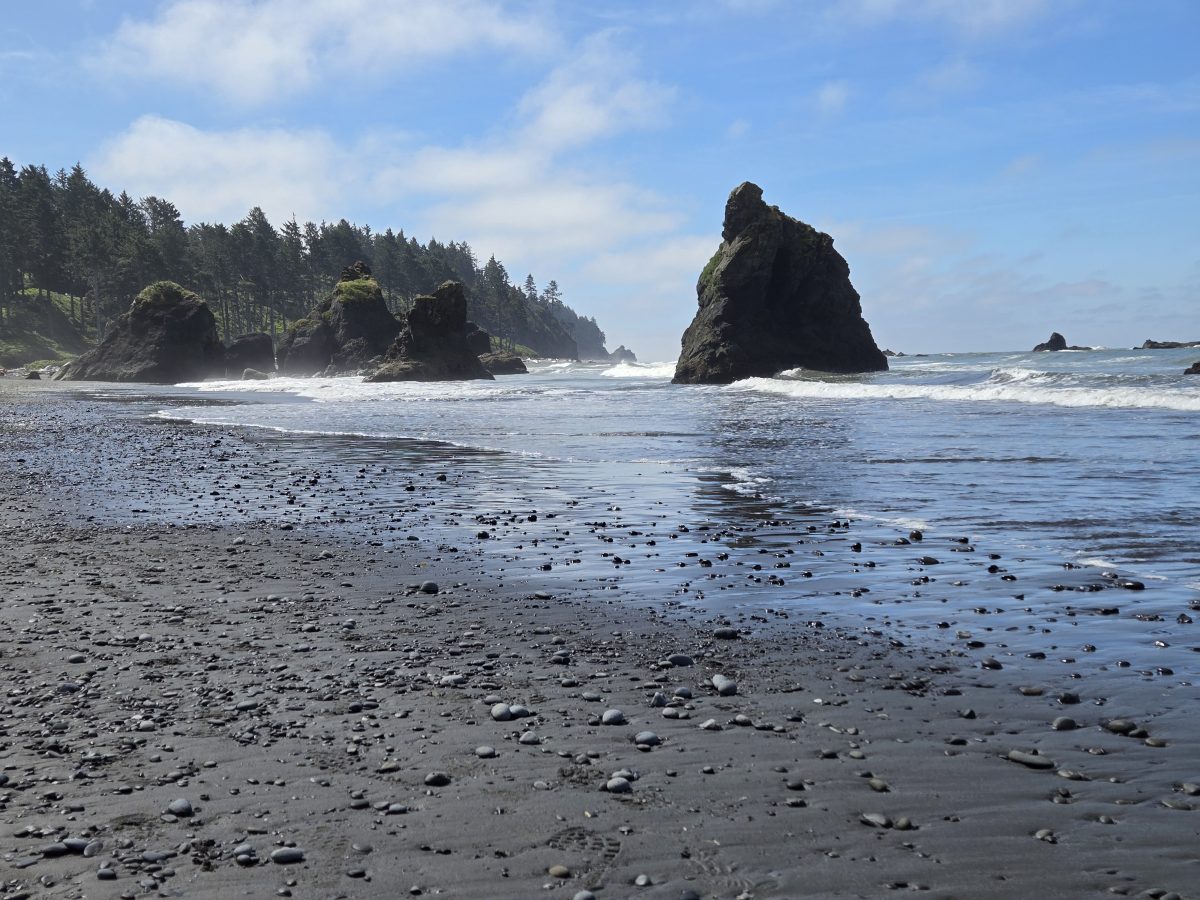
After the Hoh rainforest I made my way to the coast one more time to see Ruby Beach in the middle of high tide. No tidal pools this time but the beach itself was a perfect example of the rugged coasts of the Pacific Northwest and I spent some time there amongst the driftwood, marveling how wind and water could combine to sculpt the strange rock formations. A quick stop at a provisions store for tea (better this time) and deli meat to make an impromptu sandwich was next, followed by a four hour drive inland to Mount Rainier National Park.

I am always taken by how Google Maps will route you through some random rural roads to save a few minutes.I don’t mind it at all. As I drive through these remote communities, wondering what they do, what they believe, who are they, and how did they end up there. As you can see, it’s a common theme when I travel to consider the people around me. It’s one thing to meet people on your travels, a brief conversation or a chance encounter. It’s another to drive through their communities in the proverbial middle of nowhere as you are now in their literal backyard. 

The drive of course was exhausting as about an hour of it took place on a busy interstate and the final hour was a twisting, turning ascent up the slopes of Mount Rainier, which would have been more fun had I not been driving for hours before. I’m actually looking forward to the return trip down the mountain as I do greatly enjoy those vertiginous roads, with their winding and their switchbacks, these wonders of engineering. I enjoy them even more when I’m on the mountain side with the risk of falling off the side greatly reduced.

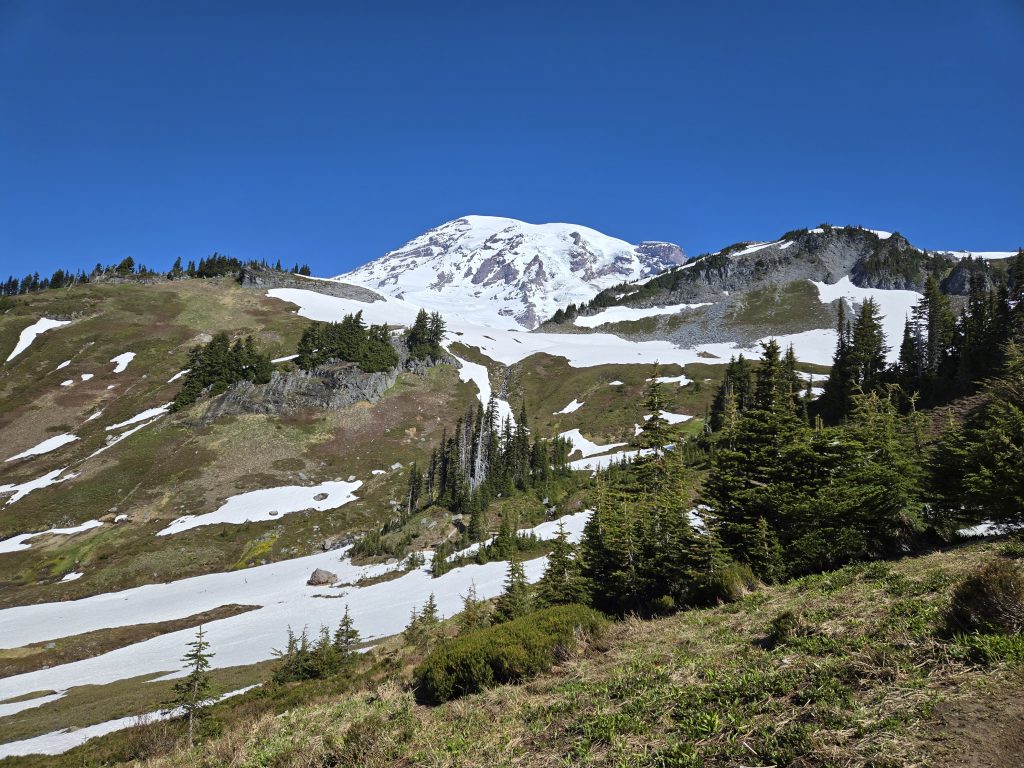
And so: Mount Rainier, a place of colossal beauty. On a day that I walked through an ancient forest, and strolled across a beach, I also encountered snow in my final hike of the day as Mount Rainier does not really hit spring in full stride until July. A short jaunt through an alpine meadow with a few patches of slushy snow that refused to melt even on a warm, sunny day was the perfect ending to an epic day.

Categories
travel

A Journey to the West: Part Two

Don’t go chasing waterfalls, as they say. It as good a piece of advice as any when exploring the natural world. Scaling mountains, sailing the seas, hiking through forests – these are travails worthy of effort. Waterfalls on the other hand are interesting accoutrements, a pleasant terminus or diversion to an adventure. When they are the sole purpose, the entirety of the destination, I find myself sorely disappointed. I haven’t been to the great falls of the earth, the Niagaras or the Victorias and their ilk, but I suspect I would feel the same of them. The waterfall to me is like a good painting in a museum: pleasing to the eye worthy of a few moments of deliberation and exploration before moving on to the next piece.

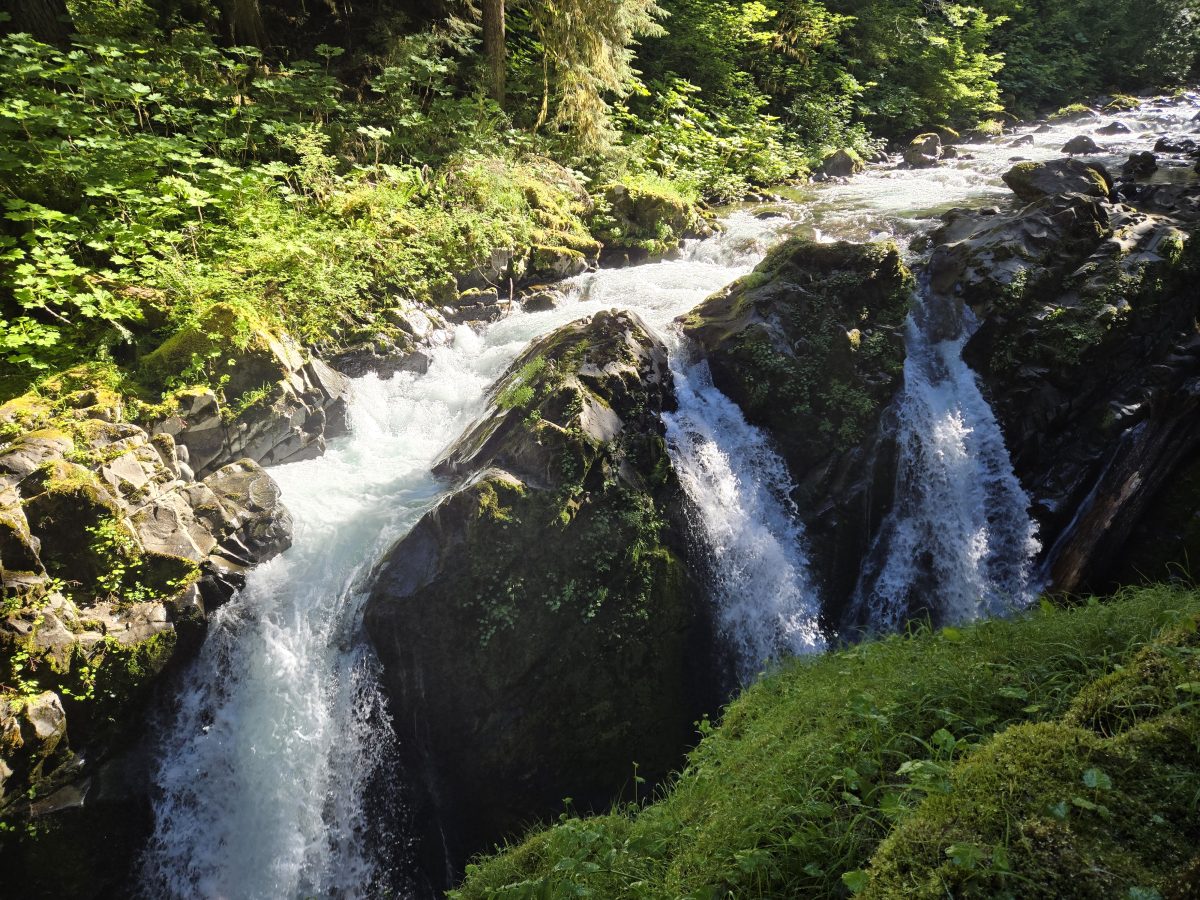
And so it was with lowered expectations that on my second day on the Olympic peninsula I ventured out to Sol Duc falls first thing in the morning. Again my east coast biological clock served me well as it was a location best experienced with as few people around as possible. While my views on waterfalls did not change because of Sol Duc, I did find myself in an utterly magical place, one where it is easy to imagine water and forest spirits gathering in halcyon days of yore. 

A short hike through a lovely stretch of rainforest led to a three-pronged waterfall that complemented the lush green of the forest around it perfectly, the minute droplets of its spray forming the slightest of rainbows with the dappled sunlight of the early morning, close enough to touch. I have no doubt that the experience would have been much different had there been hordes that were snaking their way there as I returned to the car park. With only a few other souls around it was a moving experience. 

My next stop was not on my original plan but I decided that the clock could not stop me (in this case, the clock was not some artificial schedule I created for myself but instead the timing of the low tides for my final visit of the day – which I will of course shortly come to). I entered Makah Indian land to visit the most northwestern point of the contiguous United States: Cape Flattery. Overlooking the entrance of the Pacific Ocean into the Strait of Juan de Fuca, Cape Flattery is a place of rugged beauty, its waters a deep blue as they crash into the cliffs of the peninsula. I visited on a beautiful, clear day, where Canada across the way was clearly visible, where bald eagles preened with majestic pride, where cormorants skimmed and dove the seas. It was not a particularly unique place in its scenery but there was an energy and a feeling around it, built no doubt by the dark forest of gnarled, ancient trees. It was a place the felt like that on most days it would be foggy and stormy, unforgiving even, so that visiting on a day with a fully shining sun lifted spirits of all around.

I would be remiss not to mention the truly excellent meal that I had in the Makah reservation: halibut and chips, served from a food truck sitting in someone’s front yard and eaten in my car in the lot of the Makah cultural center with relish and delight. It was delicious and, well-sated, I made my way to the final destination of the day: Rialto Beach, one of Olympic National Park’s famous coastal strips.

I timed my visit to coincide with low tide to increase my chances of exploring tidal pools. Unfortunately so too did seemingly every other person in the area and I don’t blame them given the beautiful afternoon at hand. Leaving my car more than a mile away from the beach, I trudged along the road, a bit grumpy and fatigued but resolute. The beach itself is another one that is likely more photogenic on foggier days with its odd rock formations, the pebbly sand, and the large pieces of driftwood, all framed by a verdant forest. The beach of course stretches miles on end in either direction but Rialto beach is known for its proximity to the uncreatively labeled Hole in the Wall rock formation, which is, as its name advertises, a big hole in a big wall of rock. The walk there was fine, more of a dance between sinking in the pebbly sand and avoiding the incoming waves. The real fun was in tidal pools surrounding and within the hole as it was here that I gazed on bright green sea anemones, the tiniest of hermit crabs, and deep orange starfish. 

Even on the sunniest of days the Pacific Northwest’s beaches do not forget their true nature, their ruggedness, and so this beautiful day was adorned with wonderful, strong sea breezes that did the location proud as I made my return trek. A chance decision to explore another odd rock formation brought me great fortune. I thought that orange starfish was the only one I would see – and then here was a veritable menagerie of oranges and purples, clinging on to the rocks, waiting for the high tide to return so that they could end their exposure to elements and predators.

Walking an extra mile after trudging across a pebble beach and traipsing across ragged shoals certainly does not do wonders for one’s soul. As I kept wondering if my car would be around just the next bend, I was unpleasantly reminded of a trip to the Algarve in Portugal many years ago. I had taken a bus out to a lovely peninsula for a hike that ended with a beautiful sunset behind a lighthouse. So far so good except I had another five kilometers to walk, in the gloaming and soon the dark, hoping to catch the return bus and also hoping my feet would not be destroyed, wondering if I should ask for a hitch (I did not). In any case, this walk was not nearly so dramatic as my footwear was much better and my car not so far.

The night was spent in Forks, the self-proclaimed logging capital of the world. A small slip of a town is Forks, its locals going about their lives as tourists like me, from far-flung lands, mingle for a night or two, nothing but wisps of existence, there one day, gone the next.

Categories
travel

A Journey to the West: Part One

The western United States is vast and it contains multitudes. I am always astounded at the enormity of everything: the mountains, the forests, the distances. Whenever I make my way to the pacific time zone I do so with the resigned understanding that I will be driving for countless hours over thousands of miles. It is such a different feeling from the Atlantic coast east of the Appalachians, where you can reach a major metropolis in any direction within a few hours without a major desert or lake or forest obstructing your merry progress. 

The West is different and the Pacific Northwest – and specifically the Olympic Peninsula of Washington state – is representative of the vast distances and the vast diversity of environments on offer. In its 3600 square miles, about the size of Delaware, the peninsula contains alpine, coastal and rainforest ecosystems, each resplendent and unique in their majesty and beauty.

I made my way to the Olympic peninsula as the first stop on a two week long (approximately) west coast trip and spent some time on my first day exploring its alpine offerings. First, a few words expounding on driving in the West. Yes, as I mentioned, it is countless hours over thousands of miles but there is something about the driving that feels less tiring. Probably the unending natural beauty that surrounds you, its scope and grandeur encroaching relentlessly even unto interstates in defiance of the concrete jungles that we prefer to create around our urban centers. Of course, the West is not without its mind numbing traffic and there are few experiences more frustrating than that of being stuck behind a trailer on a one lane highway no matter how pretty it is. But by and large the experience is more tranquil than the usual long jaunts.

I drove to the Olympic peninsula direct from Seattle, not stopping for a moment except as dictated by the rush hour traffic that is one of humankind’s lasting contributions to our planet. I eschewed the ferry and took instead the overland route, which unwittingly and excitingly, led me over one of the most iconic bridges in engineering history. Or, rather, the bridge that replaced one of the most iconic bridges: the Tacoma Narrows bridge. There is nothing particularly special about it in its existence but its destruction provided an unforgettable lesson for engineers and architects. Watch the video. No structure should move the way the Tacoma Narrows bridge moved before its collapse in the 1940s. Suffice it to say, the modern version is much sounder as it spans an inlet of the Puget Sound.

Eventually, after a couple of hours driving in gloriously representative gloomy and drizzly weather I found myself in Port Angeles, Washington, the northern hub of the peninsula and the gateway to the alpine parts of Olympic National Park. It is a small city whose northern coast offers a view of Canada’s Victoria Island across the Salish Sea. In the two days I spent there, having my lunches and dinners, and strolling the few blocks of the downtown, I found myself pondering how the people who lived here lived here and why they lived here. If I was a more sociable person I’m sure there would be fascinating stories of families that have lived there for generations as well as itinerant travelers who ended up putting their roots there. In many ways, it is like any other town in the country, where the population is buoyed by tourists like me but lives their daily lives like anyone else. I passed by the local high school a half dozen times and drove through residential neighborhoods. I live in the same country and I can’t think of a location as distant from where I grew up but it felt so very familiar.

The nice thing about being a visitor from the east coast is that I continue to operate on east coast time. The advantage for an avid hiker like myself means that I rise early without any undue effort and find myself at the trailhead before the hordes of other tourists. My first hike of my trip continued a timeworn tradition: for whatever reason my first hike is always the most strenuous as if a long flight and a long drive the day before refreshed my energy stores (nope: they certainly did not). And so I chose to scale Mount Storm King and laced up my boots at 8AM in a parking lot with only a handful of other vehicles.

What a name! I haven’t found its origins – though my research efforts have been light at best – but I would imagine it is drawn from the languages of the local indigenous peoples. Indeed, one legend tells a story of the rage of Mount Storm King at warring tribes at its roots, leading it to throw a boulder at the bellicants, leading to the creation of the two lakes to its north. Also, perhaps even more fantastically, 3000 years ago an earthquake caused a landslide so massive it created a mega tsunami in the larger of the lakes, Lake Crescent. Yikes…

The hike itself is strenuous. Starting with a lovely stroll in old forest growth with broad leaf maples covered in moss and surrounded by ferns, the trail to the peak soon becomes a punishingly steep ascent across never ending switchbacks. I suppose experienced alpine hikers would enjoy the climb but for the rest of us it is hard to appreciate the beauty of the firs and hemlocks and other evergreens – and indeed there is so much green – around us as we labor to eliminate the burn in our legs and hope our hearts will stop pounding in our ears.

The last section beyond the maintained trail requires ropes to ascend even for the most surefooted. I came prepared for the ropes but the physical demands of the hike almost led me to avoid them. I was exhausted. I discussed the situation with a couple of other hikers as we balanced precariously 4000 feet up and watched as a family with two youths came up behind us, obviously prepared to go up the ropes. I have mostly discarded vanity as I have matured (or at least gotten older – matured may be pushing things a bit too far) but the thought of two pre-adolescent children completing the course as I turned back was an indignity too much to bear. Ultimately it was much ado about nothing as the challenge was mostly mental and that too was more because of the fatigue of the climb up to that point.

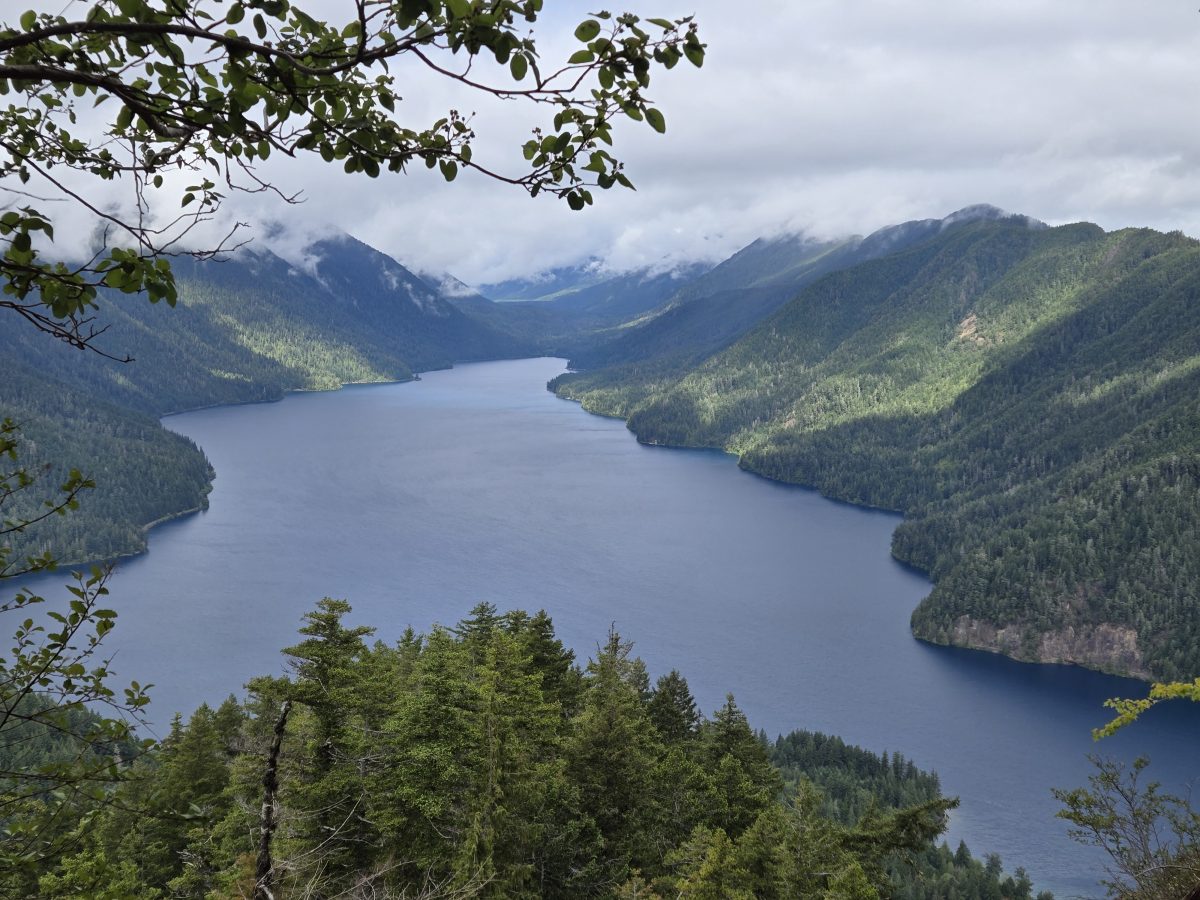
The payoff at the top was worth it. I have seen many lakes from many peaks thousands of feet above their waters but the view never gets old. Each is unique in its own right and drinking in the view is as refreshing and energizing as drinking from my thermos. I am however unfortunately a servant of another of the most pernicious of humankinds’s inventions: the schedule. If I was a simpler man with time to spare I should have spent more time pondering the glacial waters of Lake crescent 1500 meters away and the lush green valleys of the surrounding peaks. Instead I made do with a few moments of deep reflection and gratitude at the experience, the fortune that allowed me to be in that place at that time. Places to go, things to do, lunches to eat, and so forth.

The less said about the descent the better as, of course, what goes up must go down and what goes down on a mountain usually ends up with sore knees. The trail was much busier now, though not at the levels of the uberpopular hikes as it is not one of the famous ones of the park.I allowed myself some grim satisfaction watching the struggles of so many people, forgetting, deliberately, that I too was like them not so long ago. I do also enjoy eavesdropping on the conversations of hikers but there were few interesting conversations on this trail as most people were focused on gulping in oxygen to support their exertions. I did pass one mother and father, with three girls in tow, discussing Clytemnestra, rather randomly. Though perhaps not so random given this was in Olympic National Park in the Olympic peninsula with its own Mount Olympus.

The rest of the day was fairly unremarkable. A quick stop at Marymere Falls at the base of Mount Storm King was pleasant but nothing more than a photo opportunity. The big foray for the afternoon was Hurricane Ridge but it turned out the trail to the top was closed (the NPS alert was a bit misleading about this). Still, I joined dozens of other tourists to gaze on a few snow-capped peaks, which was lovely despite the yammering, and a handful of others to explore the foggy trails beyond the parking lots. This was an unexpected pleasure as the fog was so heavy that it obscured any view of the valleys below and wrapped the conifers in an ethereal blanket. It felt like walking in a cloud. Despite my inability to go further up the mountain, and despite the large crowds, I drove down shaking my head at the wonders I had seen that day – but not too vigorously as the fog was rather heavy by that point. Safety first! Get home safe!