In a last-minute decision, I recently decided to adventure out west again and visit a few national parks on the Colorado Plateau. I had originally planned to visit Italy as I have yet to explore Pompeii, which is somewhat peculiar given my avid interest in ancient history, and I also wanted to stop by Sicily, the land of the original Eureka, fulcrum of the Punic wars, one of the Muslim world’s bastions in Europe, the target of a lesser-known but just-as-consequential Norman invasion, and the site of one of the most active volcanoes in the world. But the planning became too onerous as my itinerary devolved into minute-by-minute schedules with group tours everyday and complicated comparisons of bus and train schedules. Perhaps one day I will make my way out there but I was craving a less structured trip and what better way to sate such a craving than the wide world of the American West.
My trip covered Black Canyon of the Gunnison, Mesa Verde, Arches, and Canyonlands national parks. These parks all sit on the Colorado Plateau with the final two making up the remainder of Utah’s Mighty Five parks I had yet to visit. Arches is deservedly one of the more famous of our national parks with the other three among the least visited but they are all spectacular places with a diversity of activities and all within easy driving distance of each other. My longest drive was less than three hours and it was a beautiful journey through Colorado from Black Canyon to Cortez, which sits right outside Mesa Verde.
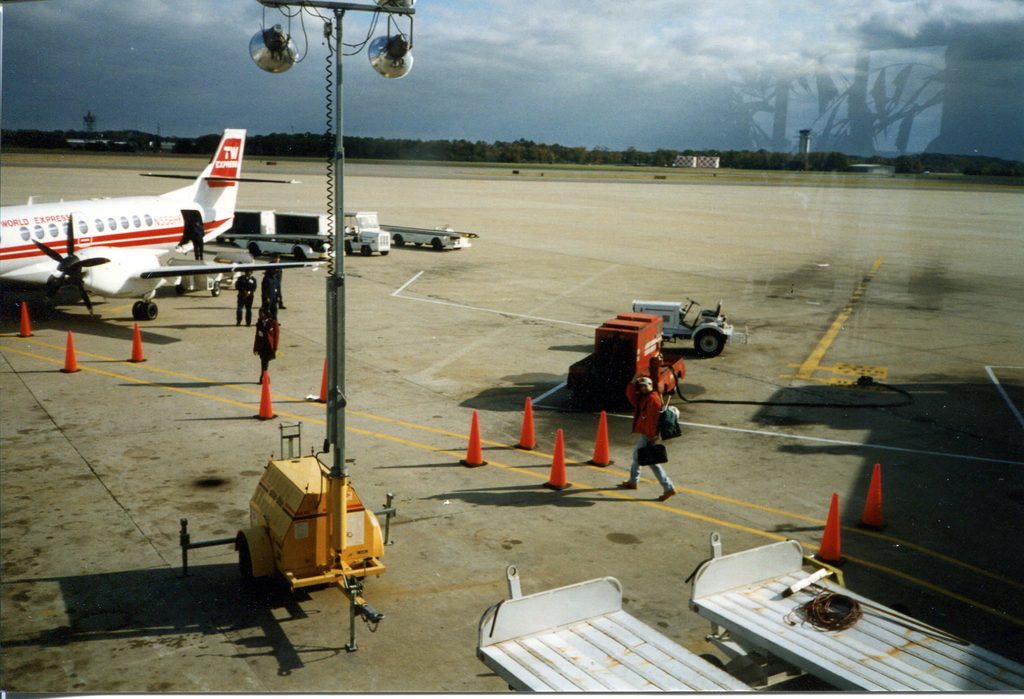
I flew into and out of Grand Junction, and spent almost no time there. The airport is a regional one and it is charming in its tininess. I got in fairly late and was eager to get to my hotel so I did not pause too much to take in my surroundings but did explore ahead of my return flight. Although explore is a bit of an exaggeration, given the airport has a total of six gates. When I first walked through, it reminded me quite a bit of my home airport growing up in Norfolk though it turns out Grand Junction is much smaller. I think what did it for me though was the short walk from the gate to the exit and seeing how close people were to our gates as they waited for friends and family to arrive.
It gave me this sharp shot of nostalgia as I thought about all of the times in days past we would go to the Norfolk airport and meet our visitors right at the end of the hallway, peering around security to try to see a cousin or an aunt as they made their final walk at the end of a long journey, waving excitedly with smiles from ear to ear once we saw them. These were late-night arrivals – earlier in the day we could go to the gate itself, whether to meet someone or send them off on their journey. Having someone wait at an airport for you is one of life’s underappreciated pleasures. It brings to mind trips to Turkey when I was younger when all of my cousins and aunts and uncles would line up behind a glass wall, watching and waiting as we picked up our luggage; or the time my cousin somehow made it all the way to passport control to pick me up. These days everything is about coordinating pick-up times and exit gates and jumping into the car as quickly as possible. Smaller airports like Grand Junction are reminders of those halcyon days of community and closeness.
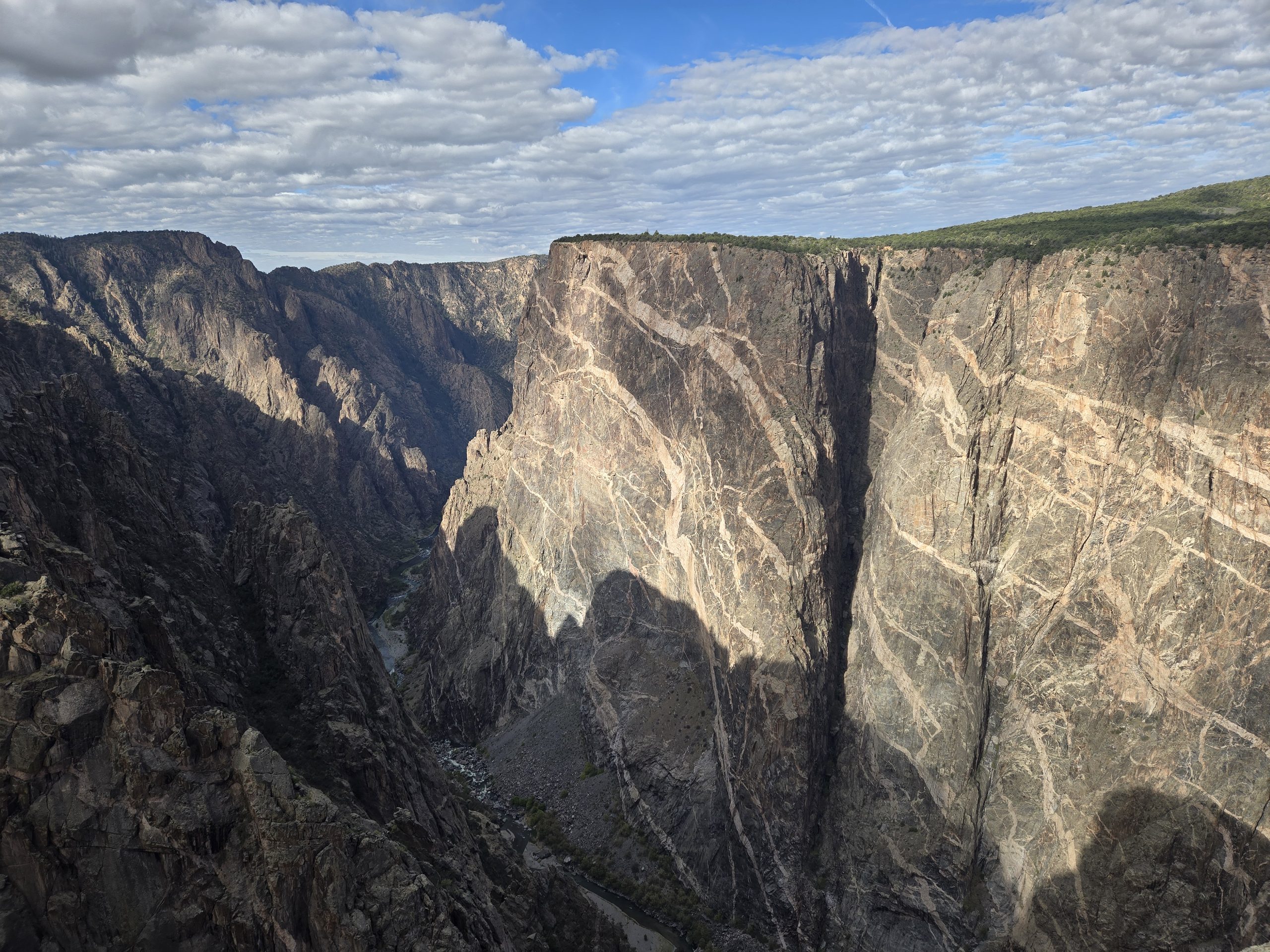
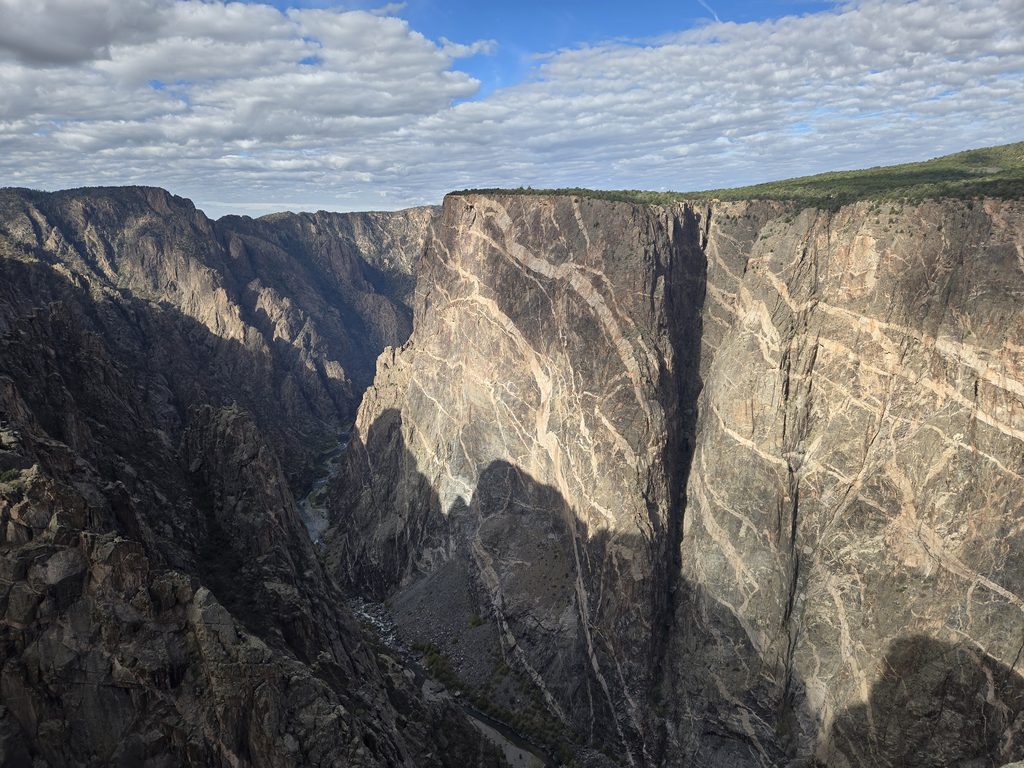
I left Grand Junction early in the morning to make my way over to the Black Canyon of the Gunnison, a spectacular and spectacularly wild canyon carved by the Gunnison river. Unless you are willing to get a wilderness permit and make a steep descent into the canyon (and keeping in mind that what goes down must come up), hiking is minimal with just a couple of trails that have nice views but are not particularly memorable. The primary activity stopping at viewpoints along the Rim Drive though most did require walking a few hundred yards. Every viewpoint rewards you with a majestic view. The canyon is not on the scale of the Grand Canyon but still drops 2700 feet at its deepest point and runs for 48 miles. Where it differs from the Grand Canyon and many others is how narrow it is. Some parts receive as little as 30 minutes of sunlight each day.
The highlight is the Painted Wall, whose pictures I have returned to multiple times in the ensuing days to ponder the patterns created by geological forces. The naturally dark gneiss rock, formed over 1.5 billion years ago, has streaks of light-colored pegmatite, which form chaotic patterns reminiscent of lightning or veins. It’s a striking and thought-provoking scene, like trying to decipher the patterns of a piece of modern art but instead the artists are some ancient gods or giants and the canvas is the face of a steep canyon wall.
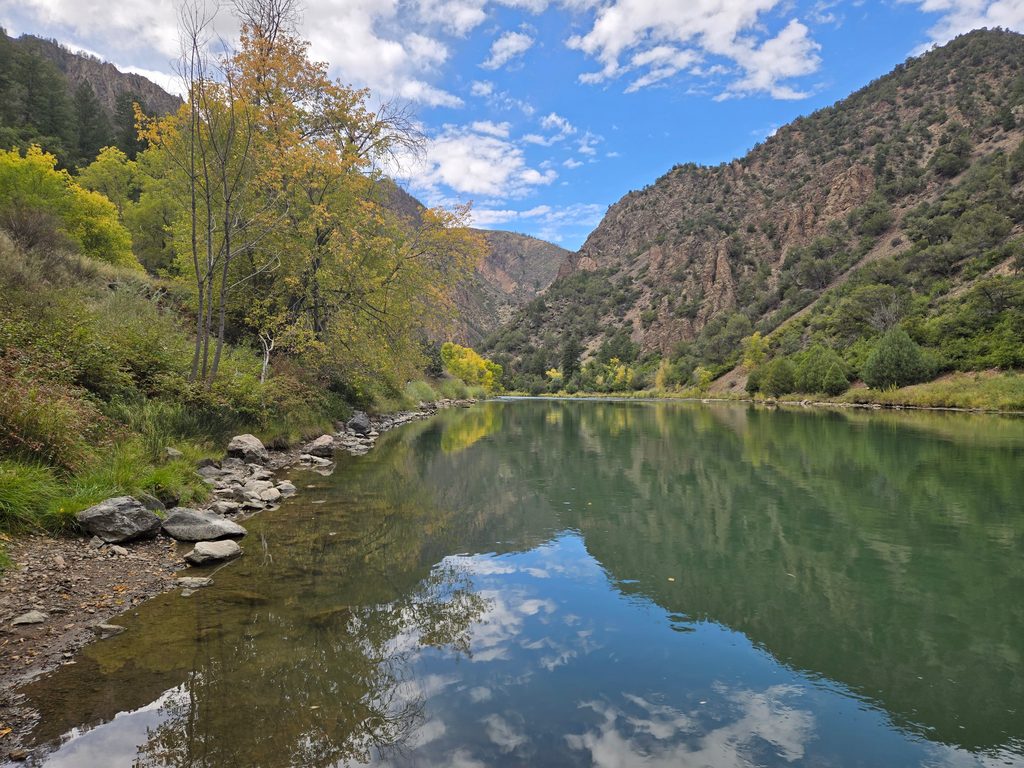
I also made my way down into the canyon, driving a steep and winding road that led to the banks of the river east of the deepest parts of the walls. The Black Canyon is already a sparsely visited park but down by the river there are very few human souls besides those who are fly fishing contentedly within the peace and quiet of the world around them. I walked for a bit along the river on a primitive trail and eventually sat in idle contemplation as the river lazily wended and gurgled on a fine fall afternoon. It was hard to believe that this river, which was lulling me into a drowsy appreciation of the wildness around me, had carved such a dramatic canyon.
Along the rim drive, the national park service put a panel at one of the viewpoints that has a quote by Wallace Stegner that I found quite moving and powerful. It is so relevant to the Black Canyon, a place that deserves to be protected for its wonders and its wildness.
Something will have gone out of us as a people if we ever let the remaining wilderness be destroyed… We simply need that wild country available to us, even if we never do more than drive to its edge and look in. For it can be a means of reassuring ourselves of our sanity as creatures, a part of geography of hope.
After leaving the park, I stopped by the nearby town of Montrose to have a quick lunch in a cafe that also operated as a candle shop and a makers space. It’s an odd place, Colorado. It was my first time in the state and as I drove through it and its various small towns many of them had a very artistic feel to them, not quite hipster such as, say, Portland and its environs, but just appreciative of the arts to the point that there was some store whose commerce was creativity even in the most rundown and seemingly abandoned of roadside towns.
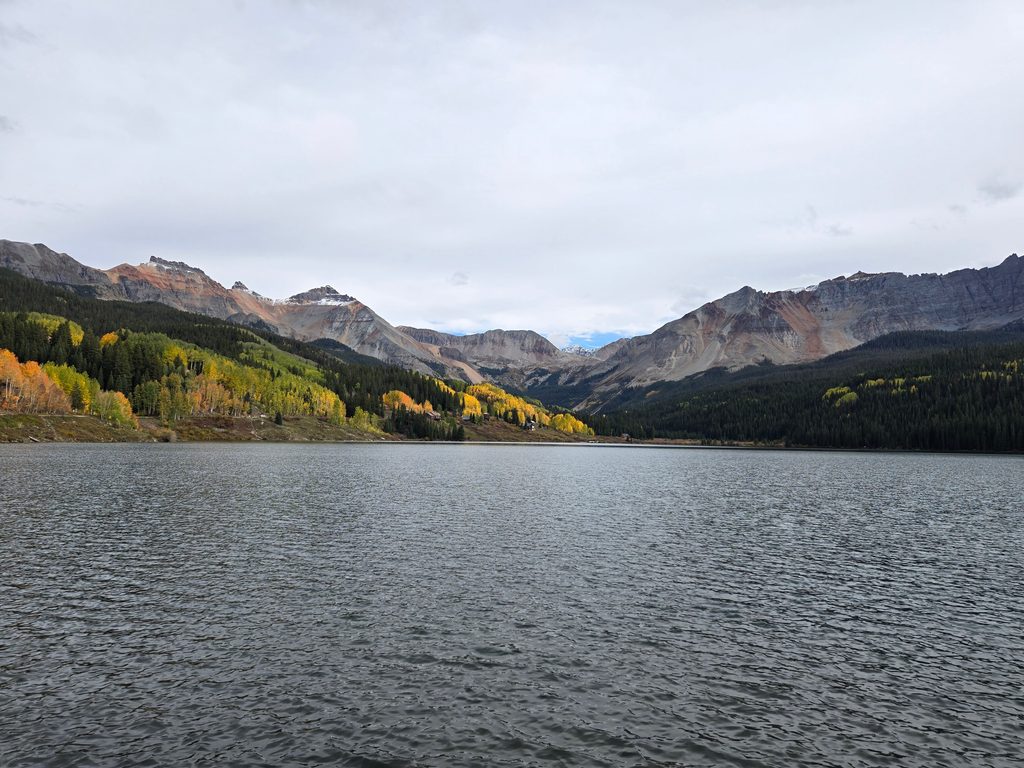
I realized later that the route I took south to Cortez, as beautiful as it was, ran parallel to another road called the Million-Dollar Highway. A lost opportunity perhaps but it’s not one I regret as my own route took me alongside rivers and aside mountains and through forests, scenes that at times were jaw-dropping enough to introduce a bit of danger to my drive as my gaze drifted from the road. While the fall of the Appalachians is much more colorful with our reds and oranges and purples, here the leaves were changing to a bright yellow. Interspersed among the deep and abundant greens of the mountain forests, the yellow leaves sparkled like bits of flecked gold, the colors vibrant in a way that only nature can create.
Cortez itself is a fairly unremarkable place that’s a touch larger than a small town though a drive around the place after dinner revealed what seems like a very pleasant place to live. I did however get pulled over by a very courteous police officer and had a polite conversation on whether I ran a red light or not. I’m not entirely sure if I got a ticket or not as the officer gave me what I can only describe as a greeting card, police department style. My drivers license has my old address on it so perhaps I’ll never know. It was an unfortunate nightcap to a long day but it mattered little to me as I knew that the best parts of my trip were yet to come.