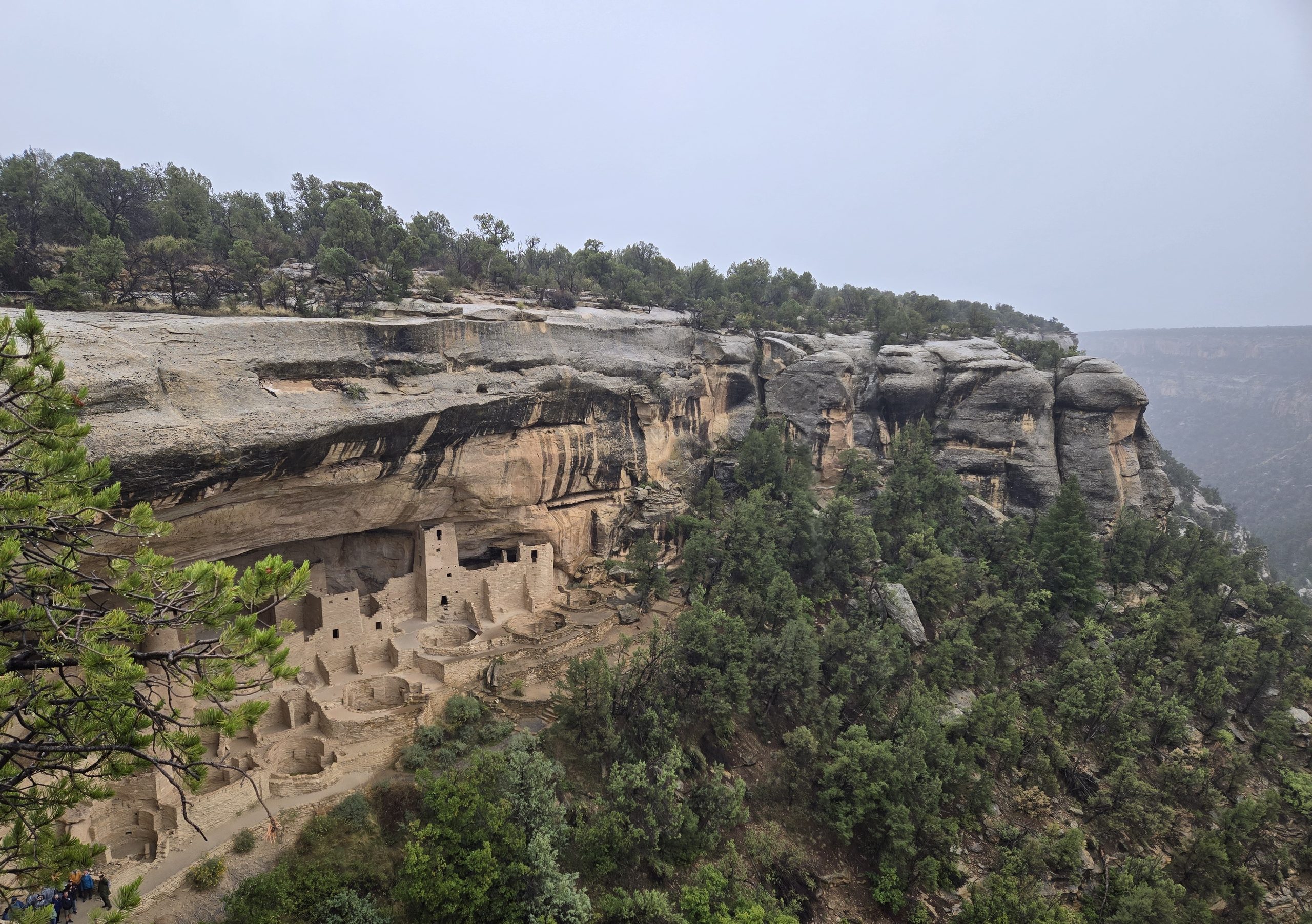
I visited Mesa Verde National Park on a gloomy and drizzly day as the weather took an unfortunate turn from the glorious early autumn of the day before. As I drove up the side and across the mesa, I cursed my fate. What should have been a grandiose landscape awakening to a rising sun instead was a mass of dark shapes, like slumbering giants, visible but barely through the rain pittering and pattering on my windshield. My rental car’s wiper controls added to my distress, as they worked in the complete opposite direction as every other car in existence, perhaps to be expected in a vehicle with the peculiar name of Trax, calling to mind a failed American Gladiator-turned-junkie.
I am, thankfully, a relatively easy-going person who tends to take setbacks in stride. I can find the positives in most situations, except perhaps when people are driving slowly in the left lane, and I soon appreciated that a little drizzle kept the temperature down and prevented a day under a beating sun. And that’s what it really was: just a little drizzle. While constant throughout the day, the rain was a bit misty, the raindrops poorly as compared to our east coast deluges. I raised multiple eyebrows when a ranger later called this the monsoon season.
Mesa Verde is unique amongst the national parks as it was set up to preserve a cultural legacy. While there are a few hikes to be done, it is primarily known as the home to dozens of cliff dwellings of the ancestral Pueblo peoples, all of which have restricted access and understandably so. I took two ranger-led tours in my day there: in the morning, I made my way to Cliff Palace, which is not actually a palace; and in the afternoon, I visited Balcony House. I had seen cliff dwellings many years earlier when I visited Canyon de Chelly in Arizona, a sacred place for the Dine people, but only from afar and with little realization of what I was looking at. Seeing them up close, and learning of their history, was more than worth getting a bit damp.
I won’t get much into the history of the ancestral Puebloans as I know very little about them and indeed it seems that for a people that left behind so much material culture there remains much still to be discovered about them. The inhabitants of Mesa Verde and the immediate surrounding areas, having dwelled there for centuries, emigrated to other locales throughout the 13th century. The reasons are not well understood as there is no written record but archaeological findings, climate data, and oral traditions all point to a conclusion that fits just about any similarly major event through history: it’s complicated and there is no one single driver.
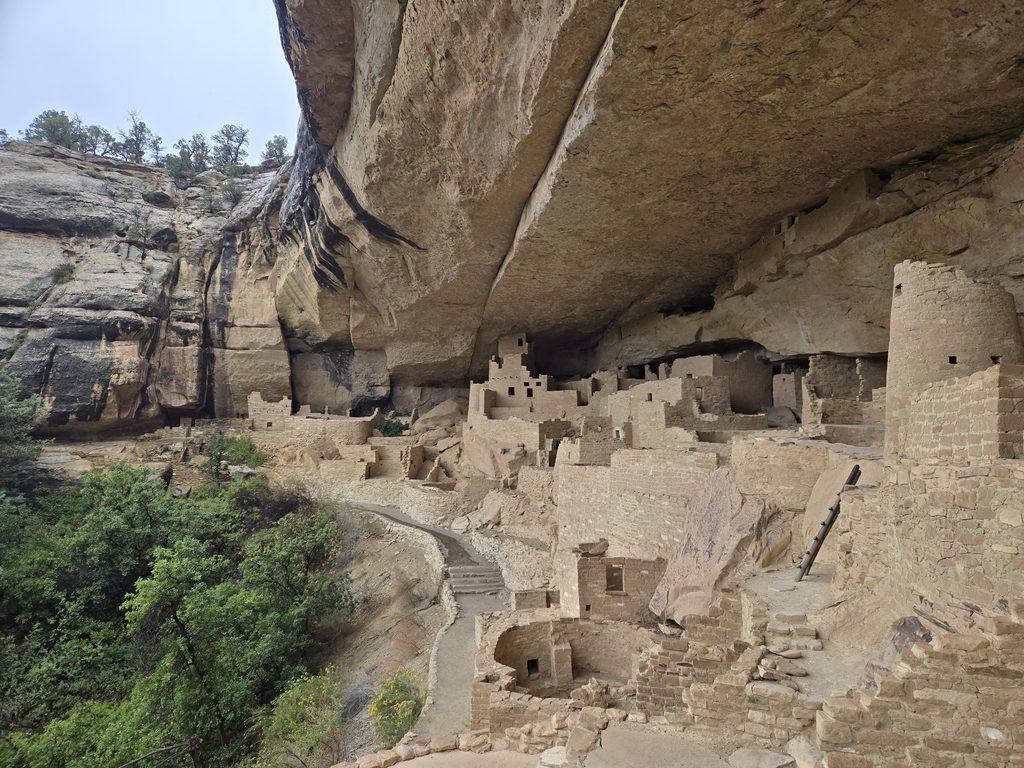
It’s astonishing how well-preserved the dwellings have remained in the ensuing centuries. A major reason is how inaccessible they are. They are literally built into alcoves and rock overhangs below the lip of a mesa, marvels of engineering and ingenuity. Getting into and out of the dwellings is not easy: our tour took us down modern metal and rock-hewn steps and up wooden ladders and through crawl-space-only tunnels. In their heyday, the inhabitants of the dwellings would carve handholds into the bluffs to facilitate climbing to and from the surface of the mesa and I’m sure used rope to transport building material into the alcove. It seems a remarkably arduous daily routine but that is a perspective of someone living 700 years later in a world of elevators and single level houses.
Whether from up close or afar, the cliff dwellings are a magnificent sight, so very different than the typical ruins (if indeed such exist) that we usually encounter. In the morning, the waiting place for the first tour overlooked Cliff Palace and I can still hear the gasp of a woman as she wandered over to the railing and set eyes on the dwelling for the first time. Many of us there felt the same: our gasp may have been in our souls instead of out loud but it was there nonetheless. It is the expression of our awe and our wonder.
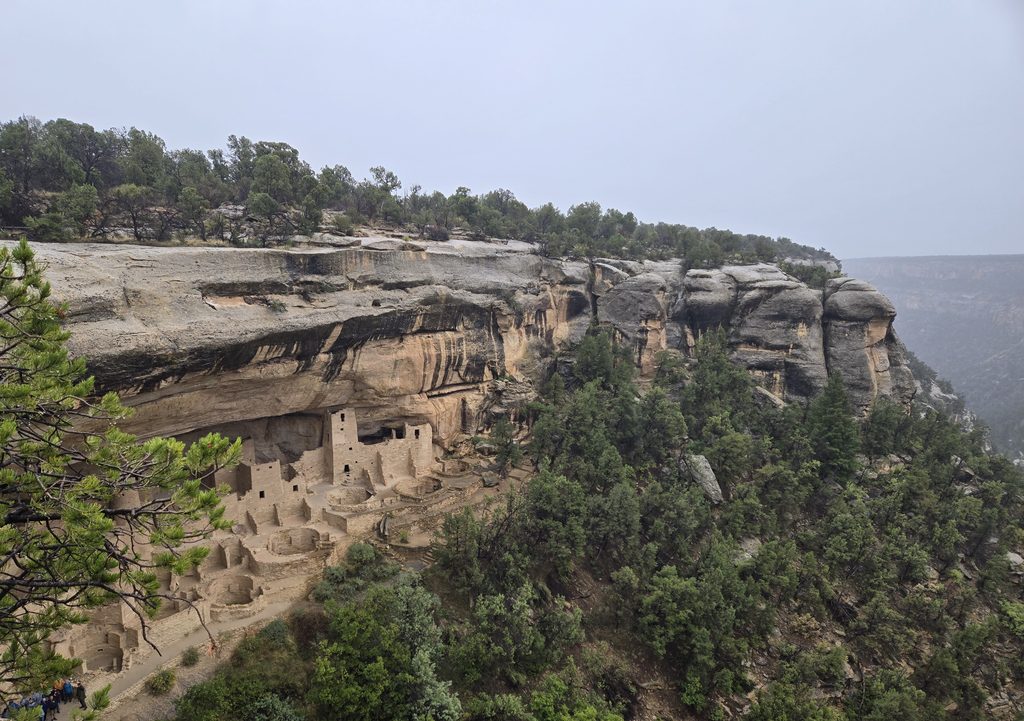
The ranger who led the tour asked a provocative question at the beginning of the first tour: putting ourselves in the minds of archaeologists 700 years from now, how would they view our contemporary culture? It gets to the heart of the intrinsic tensions of history and archaeology. We have built a corpus of knowledge that is impressive in its scale and scope – except when you dig below the surface the foundation is not as solid as we think. The amount of evidence, sources, and material culture we have is oftentimes minimal. As an example, I could confidently give you a rundown of Alexander the Great’s life and exploits… except my confidence would be misplaced as there are virtually no contemporaneous accounts of his life and our key sources were written a few hundred years after his life.
The ranger also made a snide but also perspicacious observation on our own material culture. How would the archaeologist of the future interpret our current civilization? Would they call us the Plastic Golden Arches peoples? While he didn’t belabor the point, it does touch on another fascinating and misleading aspect with historical studies. The names we give to civilizations are usually not the names they gave themselves. You’ve probably noted that Puebloan is a Spanish word. We don’t really know what these people called themselves. I’m sure that some names have been preserved in oral histories and traditions, oftentimes not shared with outsiders, and the Dine people of the Navajo nation called them the Anasazi (which is now seen as a derogatory term). This is common: the people we call Phoenicians would not have known the term and the Byzantine empire is a name applied to the state over a century after its fall.
It also touches on the durability of material culture. Surely, surely, we have generated such an abundance of material, of data, of information, that future archaeologists would be inundated with evidence, not lacking in it. That assumes of course that all of that material would survive the centuries. It’s virtually impossible to read data stored on floppy disks these days and data on the cloud is really just residing on millions of hard drives with mechanical parts prone to failure. The plastic of our landfills will easily outsurvive the medium of our words.
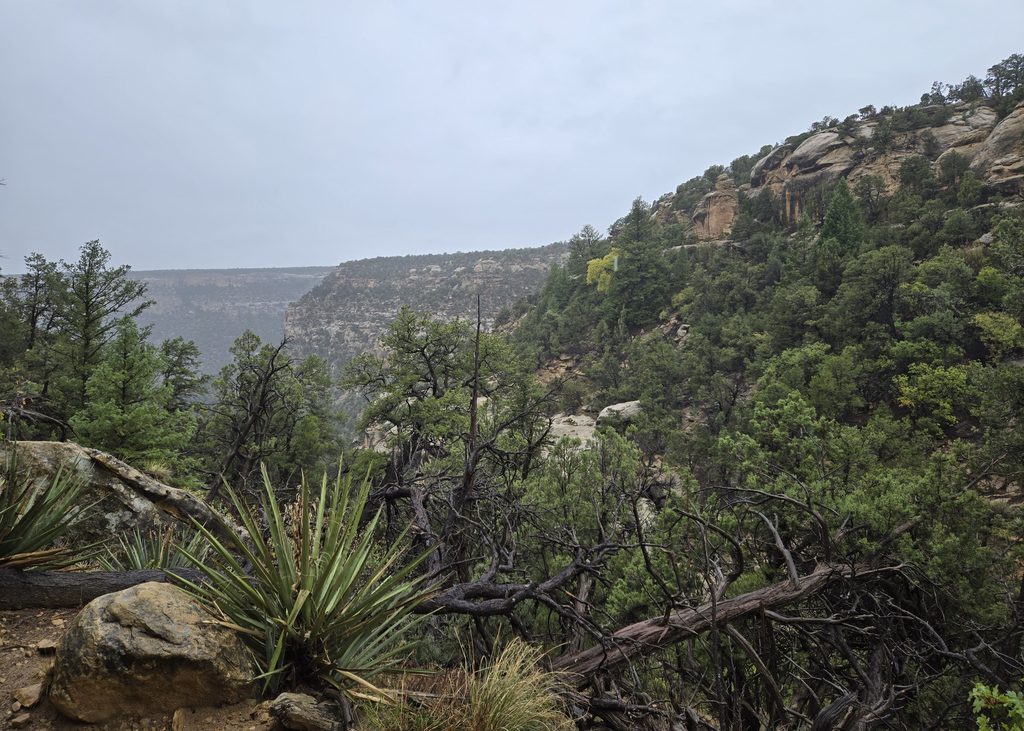
Thankfully Mesa Verde, and indeed all of the other national parks I visited on this trip, were generally well-respected by visitors as stray trash was almost nonexistent except for an empty package of Gushers I found in a remote part of Canyonlands (which also got me thinking: who takes and then eats Gushers on a hike?). I also did a short hike at Mesa Verde, the Petroglyph Point trail, which while short was still fun, despite the drizzle. Indeed the drizzle probably dissuaded most people as I only saw three people as I scrambled up rocks, took in massive views of various canyons, and jaunted through a small forest that in many parts was scarred by one of the many recent forest fires the region has recently endured. I did not see the petroglyph.
From Mesa Verde, the next stop was Moab. Most of the drive was drab: as I made my way into Utah, the weather was drab, the towns were drab, and the scenery was drab. Then, about 40 miles outside of Moab, a few miles past a town called Monticello, founded by Mormons and named for the estate of that most complicated of American Framers, the weather cleared up, the rocks turned red, and I entered a whole new world I would explore over the subsequent three days.