Categories
culture food

Food and Memory

On every visit to Istanbul, I make time to have Iskender kebap at Han Restaurant. A simple but decadent concept with origins dating back to the late 19th century, the kebap is sliced doner meat spread over toasted pita pieces, covered with tomato sauce and then slathered with melted butter, typically at the moment of serving. Yogurt is common; I always get it on the side. Some people (typically hyperbolic tour guides) claim the meal is named for Alexander the Great (Iskender is the Turkish variant of Alexander) but it is actually the name of the family that created it in Bursa many decades ago. Now the purview of specialty restaurants across the country and a fixture at many kebab and meat joints, Iskender has always been one of my favorite dishes and the one at Han holds a special place in my gastronomic heart.

The annual tradition serves as more than just a good meal. It is a remembrance of my uncle, my father’s brother. For years, Iskender would be our meal, our tradition, something we would always carve out time for. While neither of us are particularly laconic, we are not talkative either, so the meals would pass in a comfortable silence interspersed with comfortable conversation. It was one of my most important moments of any visit to Turkey. 

My uncle passed in 2019 but the tradition continues. Usually I go with my cousin but this year I ate my Iskender on my own. It is interesting how the significance of a meal increases your familiarity with it – even if you have it only once a year. I could tell that Han, like many restaurants, was adapting in the face of an ongoing and long-standing fiscal and inflation crisis in Turkey. The meal was more expensive, and yet with more pita and less meat than in prior years. Nevertheless it was delicious and gave me a space of peace and tranquility to honor and remember my uncle.
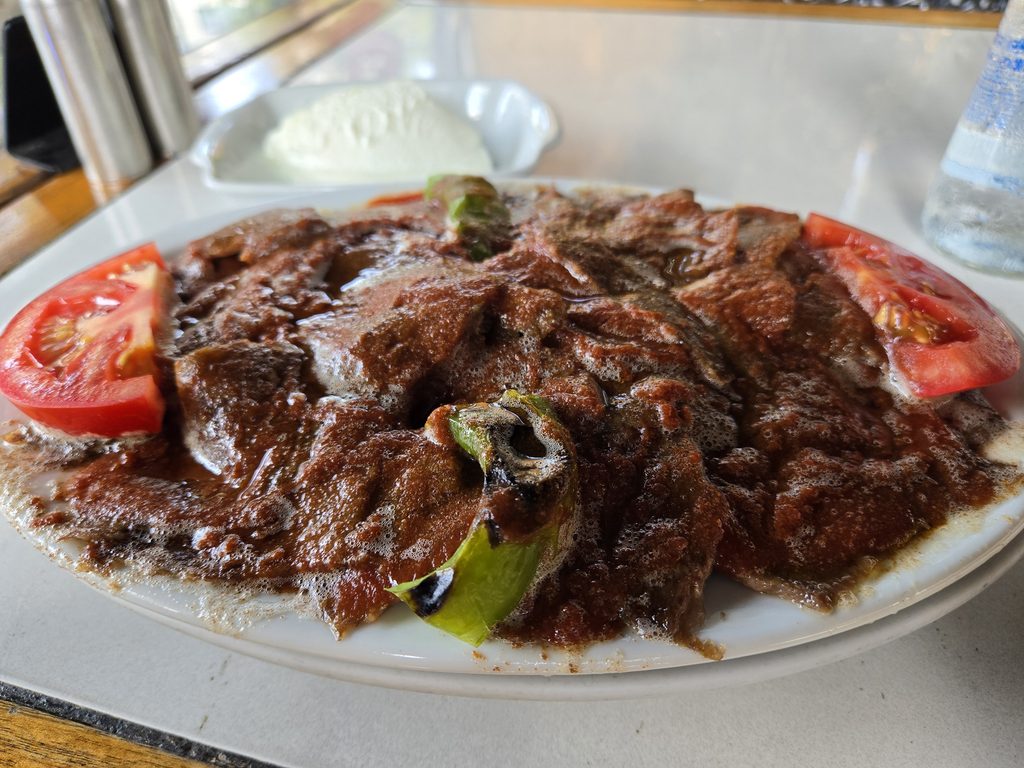
It’s not the most photogenic of dishes but Iskender kebap is classic and delicious.

It is unsurprising that food can linger long in the memory and spark emotional connection. It is a dance with our senses and so often tied to an experience or an event or a person or some other entity that has spiritual resonance. Despite being what can be both pejoratively and admirably called a “foodie,” I find that an excellent meal on its own, no matter how transcendent, is rarely one that lingers in memory. It is the experience that remains. The chili crab I had in Singapore? Truly amazing but as time goes by I remember it more for the confusion of the staff when I showed up with a suitcase (I was on my way to the airport) and the unholy mess I made while devouring it. The tuna jaw I had in Osaka was an unexpected delight. But when I think of it I can’t help but think of how I visited the food market in the middle of the day… playing hooky on a work trip to Japan (and letting everyone know I was playing hooky because, look, will I ever be back in Osaka and I’m going to experience its food no matter what).

– – –

I am not a fan of birthdays. But growing up, after I had outgrown birthday parties, my birthday did come with the distinct pleasure of choosing a restaurant. There were two places I chose and I remember them as paragons of culinary excellence, though the standards of a child and young adult may be more suspect than those of my current refined or, some may say, precious self. The Mongolian BBQ place on Military Highway remains the ideal manifestation of that cuisine, whose appellation is just as misleading as Holy Roman Empire given it is neither Mongolian nor BBQ. Those frozen rolls of meat, the generous selection of veggies, and the dozens of sauce components. Aside from the bread (uncommon in Asian restaurants and unlike any other bread I have had), the sauces are what lingers in my memory. Not the flavor but the spectacle. They weren’t pre-made fabrications like teriyaki but components: oyster sauce, ginger water, garlic, etc. all in their own pots with their own ladles. I pitied the neophyte who tried to add the sauces themselves as really you let the cook take care of it. His muscle memory let him work at light speed, putting everything into your bowl in a blur of action, with no regard at all for all of the splashing that was happening. This restaurant, whose name I only remember as Mongolian BBQ, is the one that I wish I could revisit again to reconstruct the experience: the sauces, the flavors, the bread, the paper placemats with the Chinese zodiac, the exotic thrill of 1990s globalization where immigrants and their children could dine on the cuisine of other immigrants and their children in the bowels of suburbia.
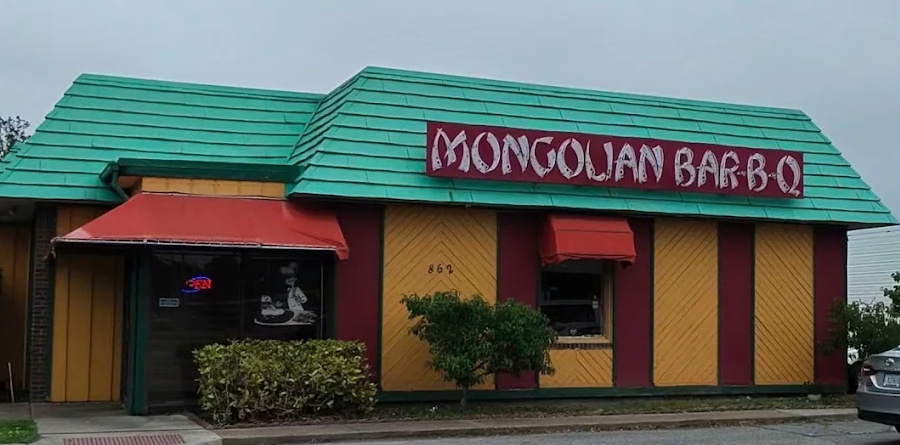
I thought it had closed. It turns out it’s still open (since 1992), it’s called Genghis Khan’s (of course), and the inside looks exactly the same as I remember it.

Another prime example of the gluttony of 1990s and early 2000s capitalism was the ubiquity of inexpensive, all-you-can-eat establishments. While these still exist, it doesn’t seem to this eater at least that the allure is the same as it was for the Golden Corrals of my youth and the Indian lunch buffets of my young adulthood let alone corollaries like the endless breadsticks at Olive Garden. One such place holds a special place in my memory: Dynasty, with all-you-can-eat mongolian BBQ, Chinese buffet, sushi, and soft-serve in a huge but ramshackle banquet hall at the bottom of a ramshackle Ramada Inn off of the busy but forgettable Northampton Boulevard. In the waning days of high school and on every break from university, my friends and I would beeline to this most average of restaurants to gorge on an endless variety of foodstuffs while in good company.

My second birthday choice was a more sophisticated one. Over time, the draw of Mongolian BBQ lessened as its food changed its quality and its shape until the point where the place finally closed. In its place, the Bienville Grill was my choice. A small neighborhood joint serving Cajun cuisine, I still remember the deep disappointment I felt when I heard it was closing as the owners wished to focus on a second restaurant they managed, one that I thought was inferior and soon closed down itself. While I am an adventurous eater, I usually end up having the same meal each time at my regular spots (my local taco place knows my exact order, as they should given I have gone there for years after yoga every Monday). At Bienville Grill, it was crawfish etouffe. It remains unparalleled in my imagination and memory, as much because it is an uncommon dish. I wonder sometimes if it was really as good as I remember it to be but that’s not really the point, is it. 

These are all examples of food outside of the home but for many people their strongest memories of food are concocted in a home kitchen. My knowledge of the Italian word for grandmother, nonna, is derived entirely from my interest in food – as it seems a nonna cannot be a nonna unless they have at least one special meal that takes hours to day to prepare (and also featured in a cookbook, a blog, or an Instagram post). Are nonna’s meatballs really the best… or do they taste better because you watched her stir the sauce for hours and hours while regaling you with stories? The flavor of food is so much more than what you put in the dish. It is the memories it evokes, the emotions it inspires, the experiences it creates. And so I say to you: live long and eat well!
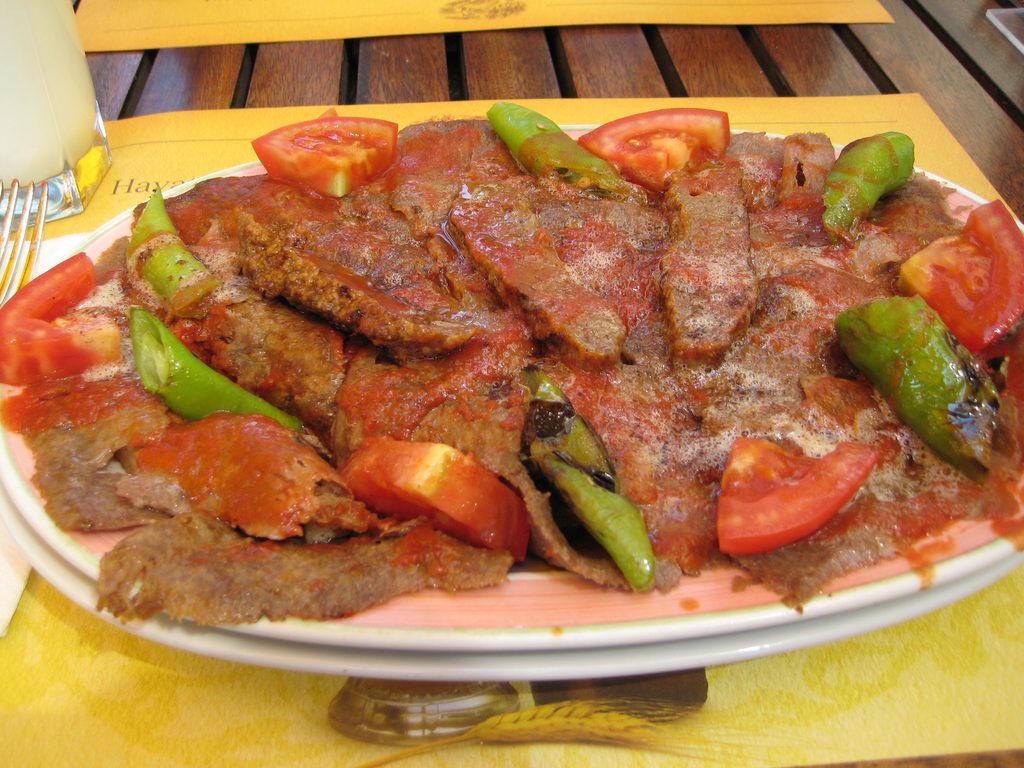
A picture of Iskender kebap from Han 19 years ago. I actually had this picture on my refrigerator, next to pictures of family, for many years…
Categories
travel

Reflecting on Istanbul. And Life.

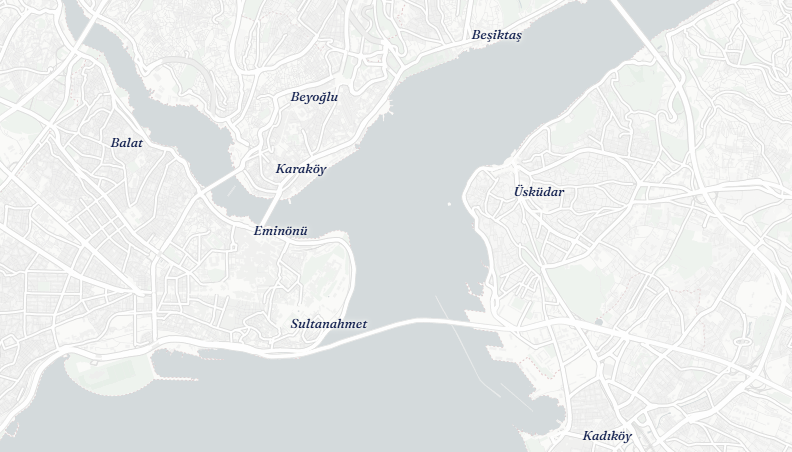
Istanbul is massive, almost overwhelmingly so. One of the world’s megacities, it is a frenetic place, without a single center of gravity but instead, like an octopus and its ganglia, distributing its masses and throngs of people throughout its vast geography. Emulating the universe at large, it is constantly expanding. Areas that only a decade ago were untouched hinterland are now dense conurbations, inexorably absorbed by the city and its rhythms. Straddling Europe and Asia, Istanbul primarily lies along the Bosphorus, which separates the continents, but has over time stretched towards the seas connected by the strait. Settlement along the Marmara Sea has been long-standing, as the ancient center lies at the southern end of the strait, while the city has gradually inched ever closer to the Black Sea, called the Euxine (“Hospitable”) by ancients to flatter what is in reality a dark and stormy and dangerous sea.

It is also, like very few of the modern megacities, an old place. While settlement of the colony of Byzantion stretches back to around 500 BCE, the history of Istanbul as a place of cultural weight and geopolitical importance truly begins in the 3rd century CE when Constantine moved the capital of the Roman empire to the east. For most of the two millenia since, the city has been the capital of two massive empires: as Constantinople of the Byzantine Empire, the center of Greek culture and religion for over a thousand years; and as Istanbul of the Ottoman Empire, an Islamic state with a vast, multicultural population that stretched from the Balkans to the borders of Iran. It is impossible to visit the city, as built-up and dense as it is, without encountering relics and influences of this history.

Zooming in on part of Istanbul (map created using Carto). For my guide to Istanbul, follow this link.

I have been to Istanbul many times but now on my annual trips to Turkey I now rarely spend more than a day or two there. It is both familiar and foreign, a skyline of cranes orchestrating the unceasing cacophony of construction. It also shares the affliction of any large city in the depths of summer, where the heat is exacerbated and amplified by the density of concrete and exhaust and humans. In the dog days of August, it is a place to escape, its heat too enervating, with scant opportunities of solace… though crossing the Bosphorus in a ferry, the breeze picking up the coolness of the deep waters below, is one of the ultimate must-do pleasures, an experience that never gets old, a marvelous daily commute for millions of people.

On my most recent trip to Turkey, I spent only two and half days in the great city, with one full day set aside to being a tourist. It was enough time to reflect on the city and life itself.

– – –

I visited a hammam for the first time in a few years. The hammam is not an experience unique to Turkish culture. But, as “civilization” has evolved and modern plumbing has become common, it is no longer a very common experience even in modern Turkey and has become more so the domain of tourists than the common citizen. The hammam, and really the art of public baths stretching back millennia to the Romans and beyond, reached its zenith of expression and sophistication in the Ottoman Empire. Among the legendary bath houses was my destination of choice, the Kılıç Ali Pasha hammam, designed as part of a larger complex by the legendary Mimar Sinan in the 16th century. It is a refined space, elegant in its architecture, luxuriously austere but welcoming in its marble, a space that not only pampers but transports you to another era of history altogether.

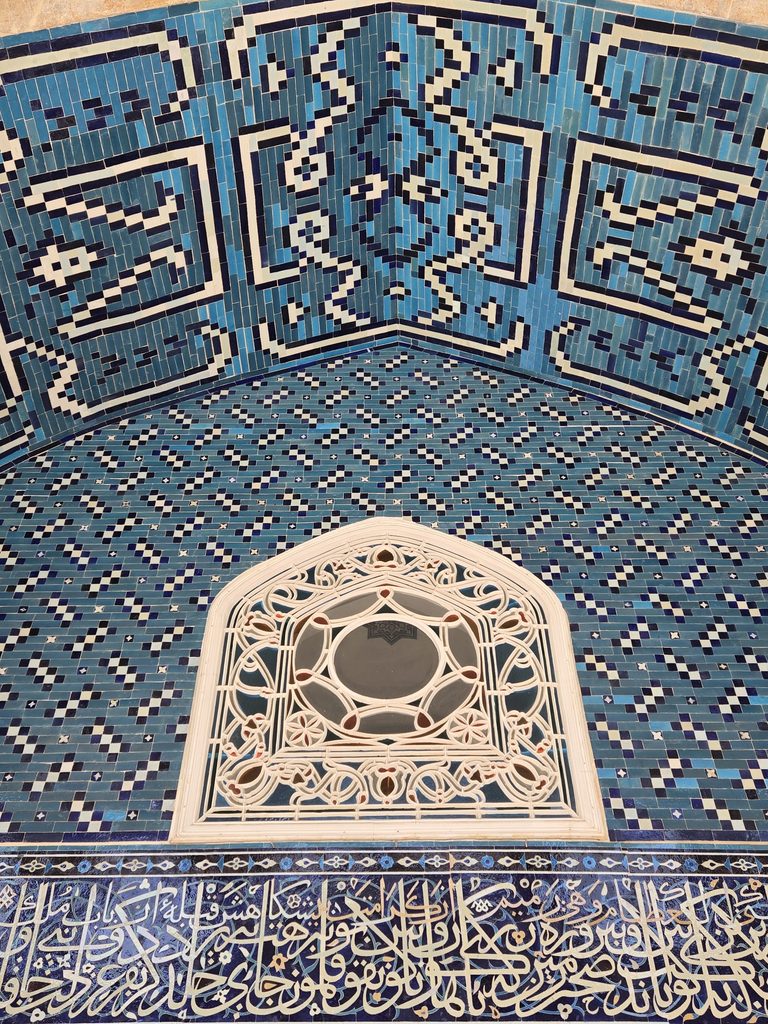
The Tiled Kiosk Museum at the Istanbul Archaeological Museums displays the type of tilework common in Ottoman interiors and exteriors.

A hammam experience is one that everyone should have at least once and you can read of its particulars elsewhere. My lingering memory is the denouement, relaxing in the inner courtyard, laying on a generously cushioned divan, sipping my tea. The door to the hammam was open to encourage a breeze. The complex itself is in a busy area (where in Istanbul is it not busy…?) but the entrance is on a lightly trafficked back passage. Still, I could see people passing to and fro, with their shopping bags in tow, or glued to their telephones, with a singularity of purpose that for those few moments I happily shed. Instead it was relaxation and tranquility, an afterglow, my phone too far away in a changing room to be a distraction or temptation. I pitied these poor souls outside, scurrying about in the heat, knowing of course that I would soon enough join them but content for the time being.

– – –

For the first time in years, probably decades, I visited the Grand Bazaar, celebrated for its size, its history, its crowds of visitors, the aggressive salesmanship and bartering of its shopkeepers, and its hidden passages where true treasures can be found. On a weekday afternoon, the place was not as busy as it could be so my wandering was pleasant and I activated my resting bitch face, Turkish mode, to dissuade over-enthusiastic touts. I purchased a few souvenirs and then toward one of its many exits, I entered a textile shop to get some peshtemals, those most practical and utilitarian of Turkish towels, and sparked a memory of years past. I asked the shopkeeper if they were in this location nearly twenty years ago as I was certain I had visited it before. His response: the shop has been in the same location, run by the same family, since the 19th century. There is a satisfaction, a concreteness, to the knowledge that as so many lives and callings and industries succumb to the flow of modernity, there are some traditions and families that persist and persevere. For how much longer, one can only wonder and hope.

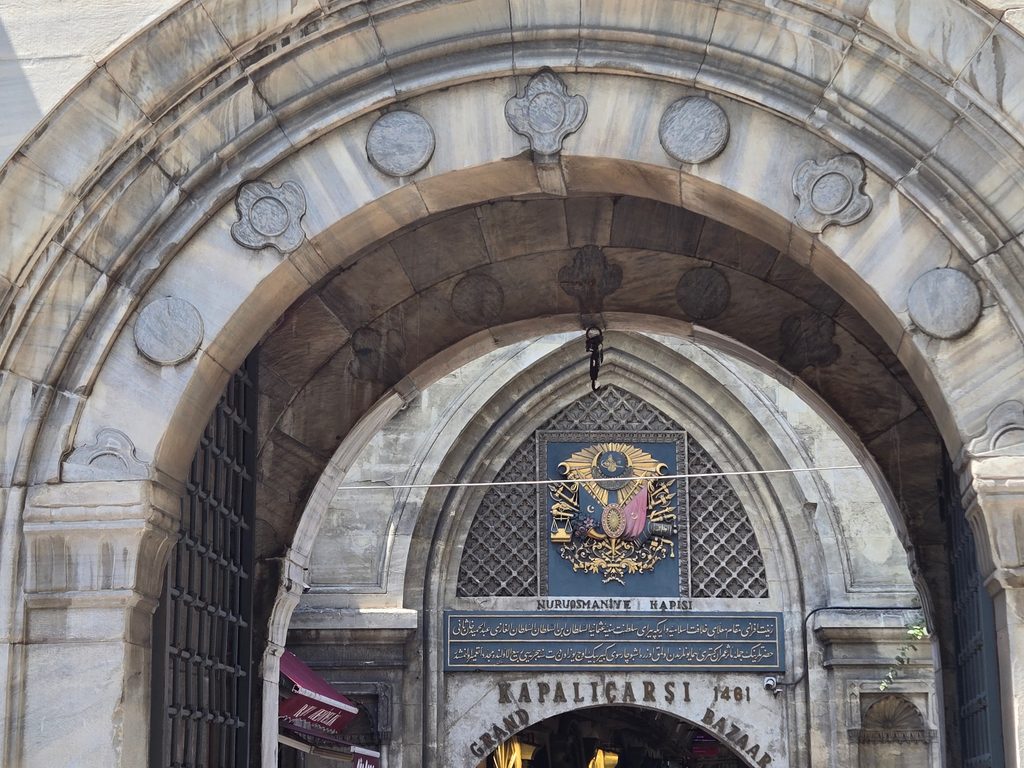
One of many entrances to the Grand Bazaar, this one passes by the Nurosmaniye Mosque.

I took my usual route down to the waterfront by passing through the Spice Bazaar and soon found myself regretting the decision. The streets between the two bazaars are wide enough (and thankfully downhill) and eventually closed to vehicles. Yet there is a point where the mass of people are so large, so dense, that you can move only shoulder-to-shoulder, bumper-to-bumper as it were, in constant threat of being jostled or bowled over. At the time it was a horrible experience, in retrospect exhilarating. Any language you can imagine was echoing on the streets. Families were navigating the crowd with young children and suitcases in tow. Porters were skimming through, somehow balancing meals and tea on trays held above the canopy of heads, delivering sustenance to shopkeepers. Motorbikes, ignoring the interdiction on motored vehicles, added further complexity, their engines and exhaust and recklessness just another obstacle.

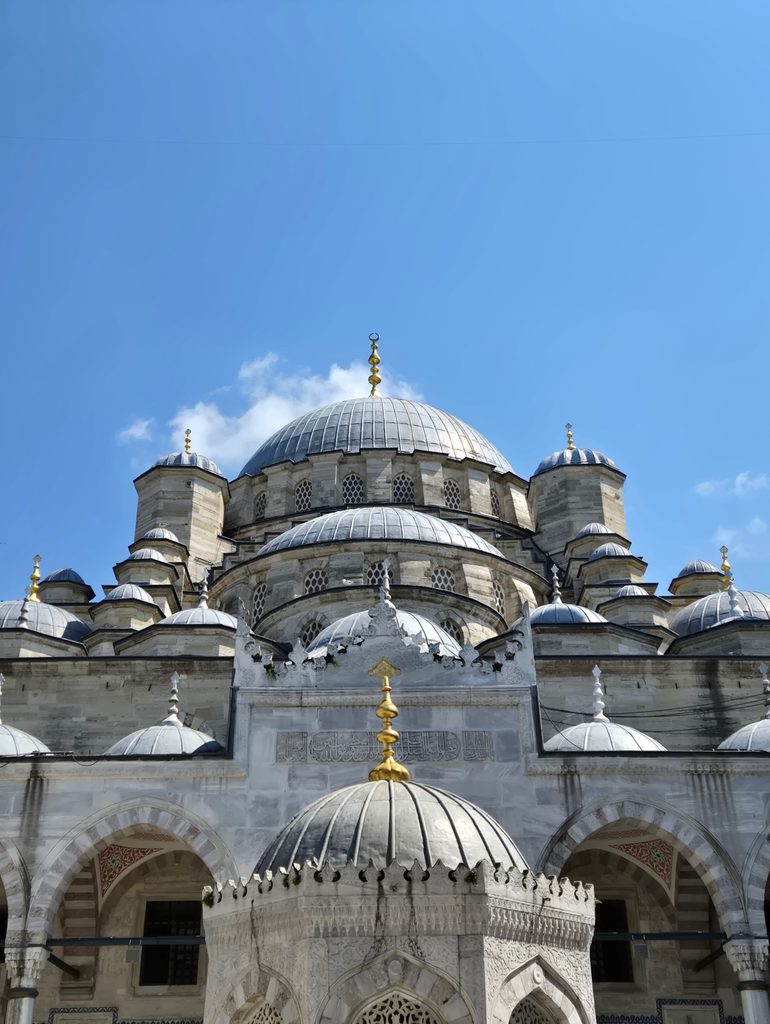
There was no organization to this chaos. It was raw and unfiltered and yet everyone got to where they were going. As did I, passing through the bazaar and the alluring displays of spices and dried fruits on offer, eventually resting in the lovely courtyard of the New Mosque (relatively new at least, it was completed in the mid-17th century) before walking across the Golden Horn to enjoy the famous balık dürüm in the backstreets of Karaköy.

The Yeni Cami and its courtyard provide respite from the crowds without.

– – –

The vast majority of tourism in Istanbul concentrates on the European side and understandably so. That is where ancient Constantinople with the Hagia Sophia, Blue Mosque, and Topkapı Palace lies. Across the Golden Horn is Beyoğlu, the cosmopolitan heart of the city, starting at the waterfront with Karaköy and moving up past Galata to Taksim. A bit further north on the European shores is Beşiktaş, where tree-lined avenues lead visitors and locals alike to newer Ottoman palaces and lovely waterfront areas like Ortaköy, sitting below the first of the three suspension bridges that traverse the Bosphorus. If a tourist makes their way to the Asian side, it is most likely to Kadıköy, another pocket of chaos and history in a city full of both. There, and towards the posh and cool neighborhood of Moda, the streets are narrow, unplanned, uphill and downhill, lined with shops and vendors and restaurants of all kinds.

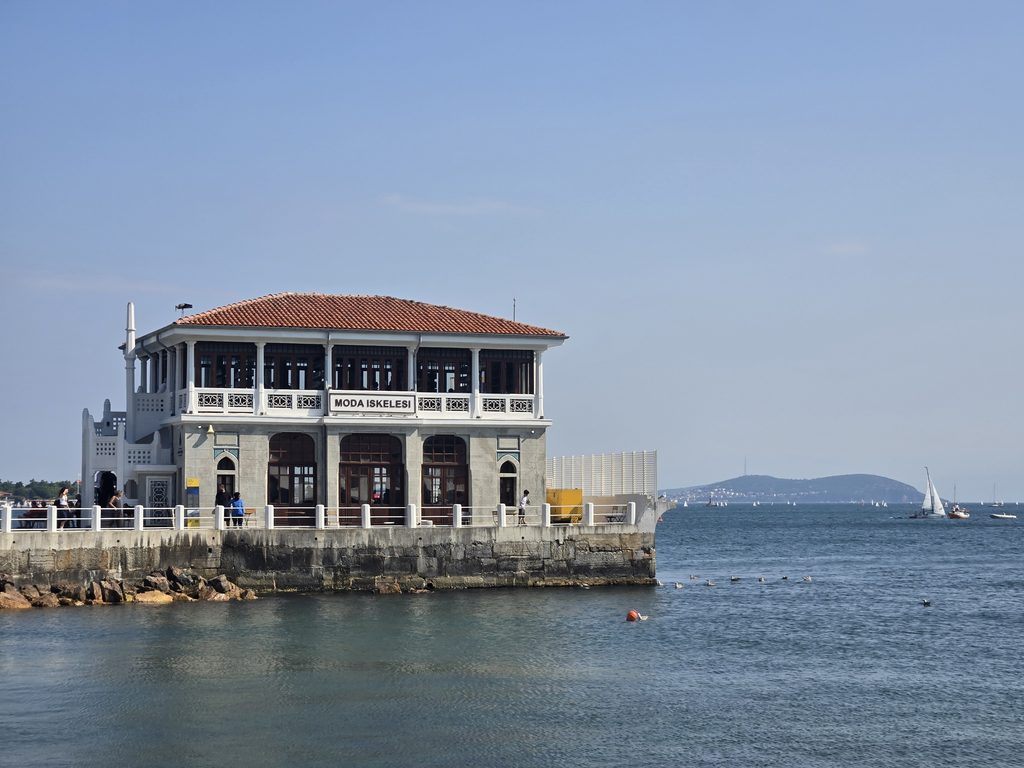
Built in the early 1900s, the pier at Moda recently restarted ferry service after lying dormant for a decade or so

In one wider and busier thoroughfare, I joined a cousin and an aunt at a Fazil Bey, sitting in some rickety chairs and a rickety table jutting into the street, lingering in conversation over a Turkish coffee. My distaste of coffee is well-documented and widely known. I instead favor that most noble and elegant of leaves and drinks – tea – but I always make an exception for Turkish coffee, as long as it is in shared company and shared ritual. It is not something to be had quickly; the world slows down for Turkish coffee.

And, oh, the people you can watch anywhere in Istanbul! Here there were locals doing their daily shopping or simply meeting with friends and families. Old men, bent by age and burden, carried heavy loads of window panes or other construction material to and fro, laboring however they can in hope of enough for their daily bread. Tourists, bright-eyed though confused by the chaos, strolled by with their backpacks and wandering gazes, trying to make sense of the maps on their phones and their applicability to the reality of the streets, mentally drafting their Trip Advisor reviews. It is an unending procession of the diversity of purposes and personalities, so similar and so different in their life experiences.

– – –

For years and years, I hadn’t been to the Istanbul Archaeological Museums and I was most excited about visiting, especially as I have grown more and more interested in archaeology. I am an avid subscriber of Archaeology Museum and in my list of priorities should I win the lottery is funding archaeological expeditions. (I usually buy a lottery ticket when I get gas and proceed to daydream for a few moments on what I would do if I were to actually win. My best idea so far is kind of like a modified Make-a-Wish: I will fund a bucket list item for you but I also have to be there. Want to be front row at a Taylor Swift concert? I will join you. Want to visit Antarctica? My parka is ready to go. Etc.). Had I a different personality type, I could imagine myself as an Indiana Jones albeit more respectful of the material culture. But I am just as content wandering the exhibitions of museums.

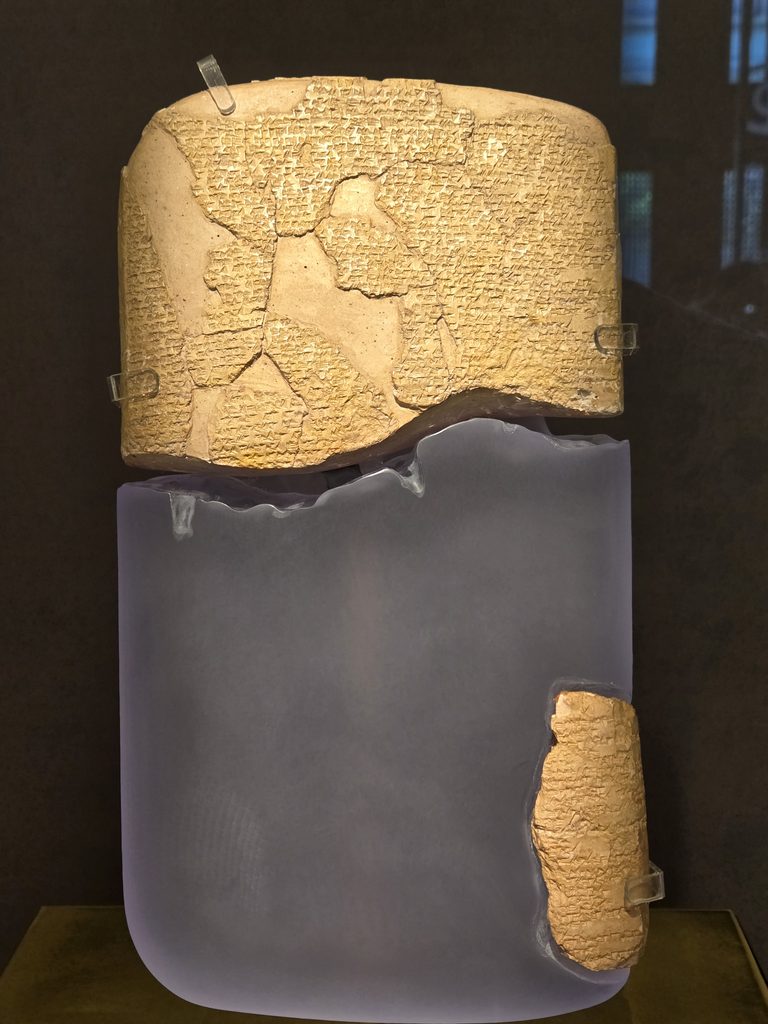
The Hittite version of the Treaty of the Kadesh. So small but so monumental.

The Istanbul Archaeological Museums are three complexes: the main museum, a museum of the Near East, and an old pavilion with tiles and mosaics. There are shaded areas with trees to escape the heat and it’s generally a pleasant place, not quite at world class level but with many important and fascinating artifacts. I nerded out over a copy of the Treaty of Kadesh, wondering at how physically small it is, contrasting with its outsized place in history as the oldest surviving peace treaty. Ancient Assyrian and Sumerian tablets covered diverse uses, from the oldest marriage certificate and school tablets to a recipe for poisoning and the oldest love poem. Interestingly it is written by a woman, most likely as part of a song sung by the bride of a king wedded on behalf of Inanna, goddess of fertility and love. I will let you, dear reader, judge its merits and ponder how and if expressions of love have evolved in the ensuing millennia.

Groom, beloved of my heart
Your beauty is great, sweet as honey
Lion, precious one of my heart
Your beauty is great, sweet as honey

– – –

Groom, let me caress you
My previous caresses are sweeter than honey
In the bedchamber, honey filled
Let us take pleasure in your beauty
Lion, let me caress you
My precious caresses are sweeter than honey
Groom, take pleasure from me,
Tell my mother, she will give you beautiful things
My father will give you gifts

– – –

Because you love me,
Please give me your caresses.
My lord, my god, my lord, my protector,
O Shu-sin, who pleases the heart of the god Enlil,
Please give me your caresses.