Categories
travel

Albania and Identity

Here’s a bit of trivia: my great great grandfather, Mehmet Deralla, was the first Minister of War of the first Government of Albania, created toward the end of 1912. It’s a bit of trivia that’s useful for truly trivial moments, like silly icebreakers in corporate gatherings, but also one that holds a prominent role in my family history. Like millions of people around the world – and as attested by the continued popularity of platforms like Ancestry.com and DNA tests – I am quite interested in my genealogy and family tree. And like many families in Europe and the Near East, my predecessors were affected by the revolutionary zeal and political realignment of the post World War I era, leading to fascinating stories of survival, migration, and thriving.

Originally from Tetovo (which is in the modern state of North Macedonia), Mehmet Pasha’s children and descendants for various reasons dispersed, many moving to what is now Albania and at least one branch, through my mother’s grandmother, ending up in Turkey. Therefore, despite the remove of several generations, Albania has always been a place of interest for me, always on the periphery of my identity. So on my recent trip to Turkey, as I was considering excursions, the obvious in retrospect decision was a trip to Albania. In four wonderful days, I spent time with family I had never met before, explored (unfortunately too briefly) different parts of the beautiful country, and pondered that most enjoyable of self-reflective questions: who am I?

National, ethnic, and cultural identities are key parts of the modern persona. National identity is still relatively recent in the history of human civilization but is increasingly becoming the most important as local cultures amalgamate into monocultures (or as the uni-context dominates our lives). Most of us, when asked “what are you,” would list our nationality near the top of our identities. I am an American, born and raised, both critical of its history and a believer in the ideals the nation was founded on. I also identify as Turkish from a cultural perspective – though the lines blur as I root for the Turkish national football team – as I speak the language, embrace many of the traditions, and have a somewhat spiritual, for lack of a better word, connection to the land. It is a privilege to be so steeped in two different cultures as it gives me a very different perspective on life, the universe, everything. It also drives the identity that supersedes both: I am a human being, a citizen of the world. But that’s a digression for another day. Returning to the point at hand, I now wonder: am I also Albanian? How far back does the connection have to go or is the nature of the connection more important? Does it even matter?
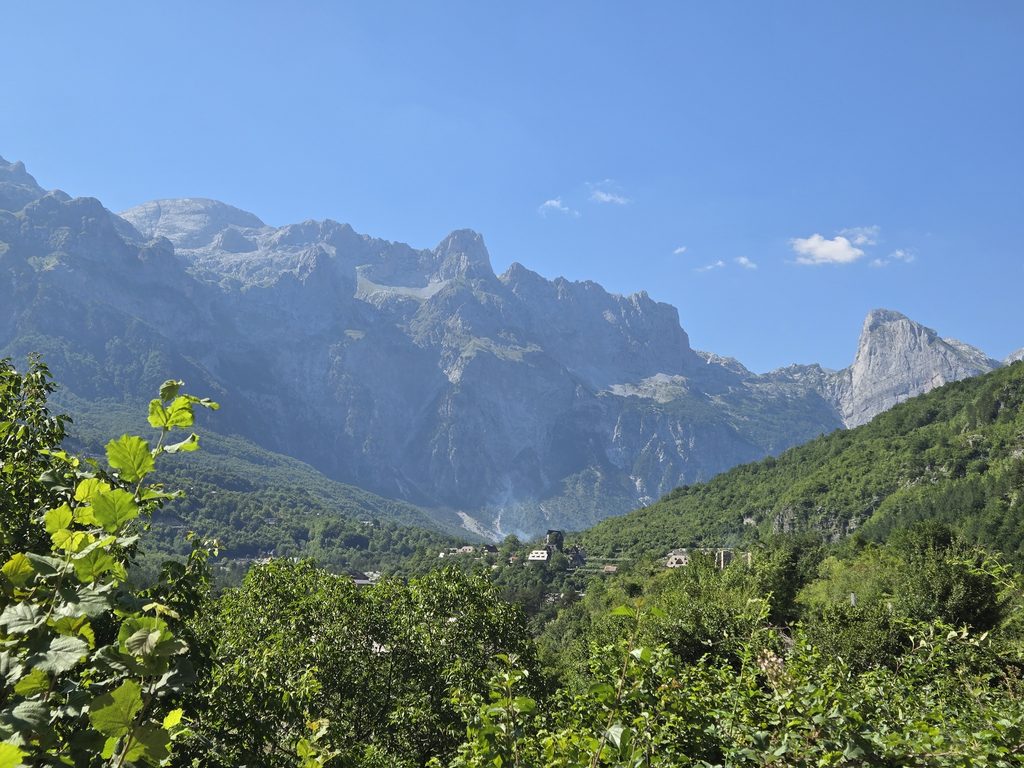
A small village nestles in the valley of a majestic mountain range in northern Albania

Before heading to Albania, my aunt connected me to Merita Teyze (teyze in turkish has the dual meaning of your mother’s sister and a general “auntie”), who in their youth was pen pals with my mother. All three are great-grandchildren of Mehmet Derrala and so we all share a common ancestor. It’s difficult for me to articulate the warmth, the almost disorienting hospitality, the connection I experienced in Albania. The family contingent when I visited was small as the diaspora has expanded throughout Europe and America, while others were on their summer vacations. But the connective tissue of family, despite its geographical dispersion, was obvious and evident. And I was just part of the family. Not a matter of being accepted or anything like that, more so just a matter of that’s just the way it is.

– – –

Albania is a beautiful country and I spent some time exploring. My first trip, an epic 14-hour day, took me to the northern mountains – called the Albanian Alps in a bit of a marketing ploy – to experience wildly winding roads with steep drop-offs, majestic peaks, and incredibly blue natural springs. Here I learned more about the culture of Kanun in northern Albania , a part of the world that is not completely remote or cut off from the modern world but, despite growing tourism, mostly of pale British youth in their quest to turn lobster red in the beating sun, is hard enough to reach that it feels novel and virgin. The country’s geography is generally mountainous, and generally unexplored and unknown to the outside world, which lends an additional layer of discovery and awe to gawking tourists like myself.
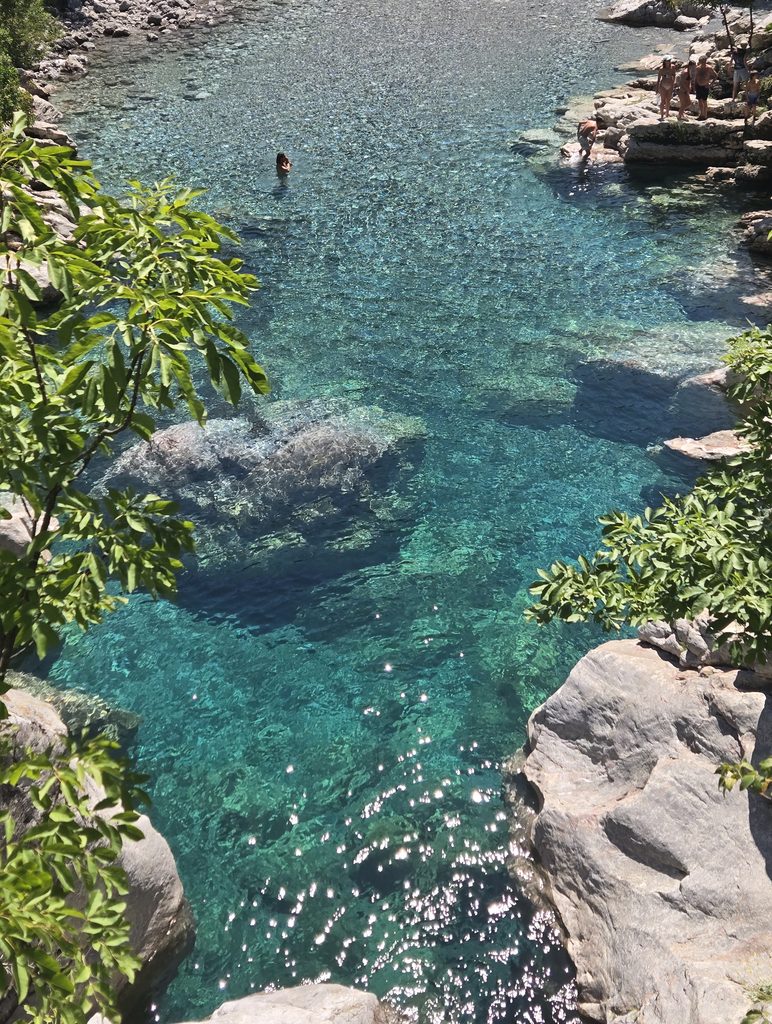
The springs in the northern mountains are one of those pictures-don’t-do-it-justice shades of blue

That tour was a small group while another I took to Berat was on one of those exasperating tour buses, the land equivalent of the large cruise ship, a blight on the landscape, vomiting out throngs of tourists out at each stop. Thankfully, there are not too many of these mega-buses, again because of the relative touristic obscurity of the country (though that will no doubt change – a country this beautiful and diverse, with a people so welcoming, will no doubt attract more and more visitors). An ancient site, Berat is an interesting place with a castle that stretches back to the Byzantines looking down on the plain far below. There lies a medieval town, whose architecture and old neighborhoods persist from Ottoman times. Slow, winding roads wend their way up and down historic districts separated by a small river, the shade of the alleyways and church courtyards giving brief respite from a furious sun (I visited in the midst of the ongoing European heat wave). Among the stone houses, I had a delicious traditional meal of stew and local wine to fortify me for the increasingly weary steps as I sought to explore every corner and crevice of the charming town.
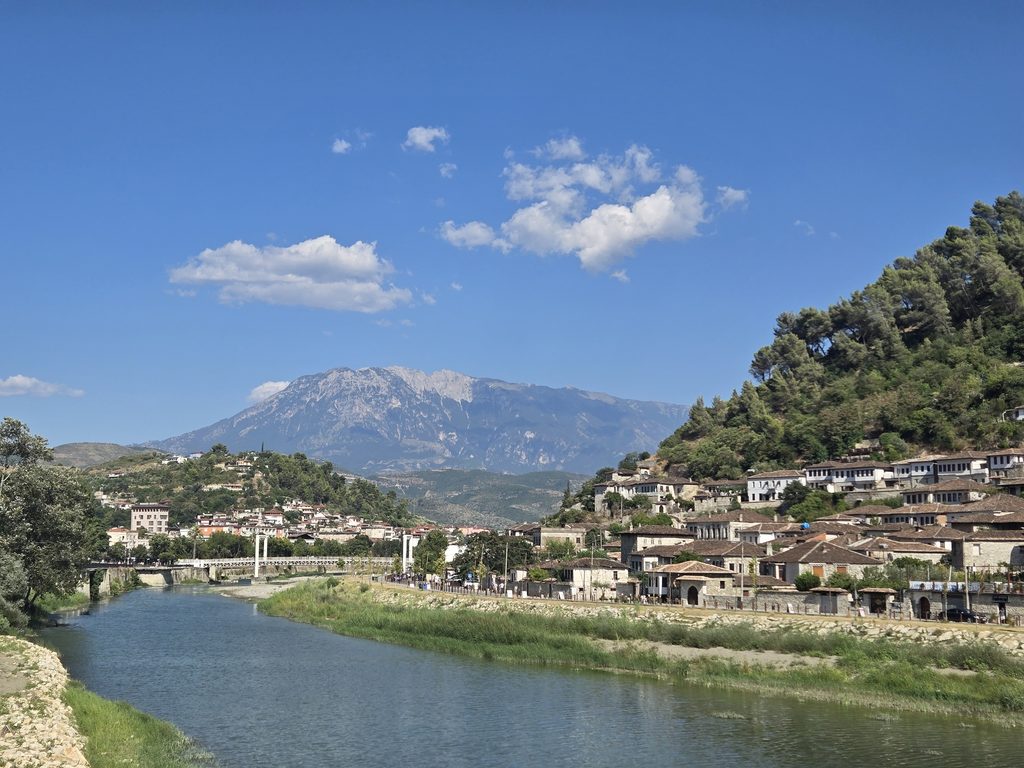
A view of the river and Gorica district in Berat
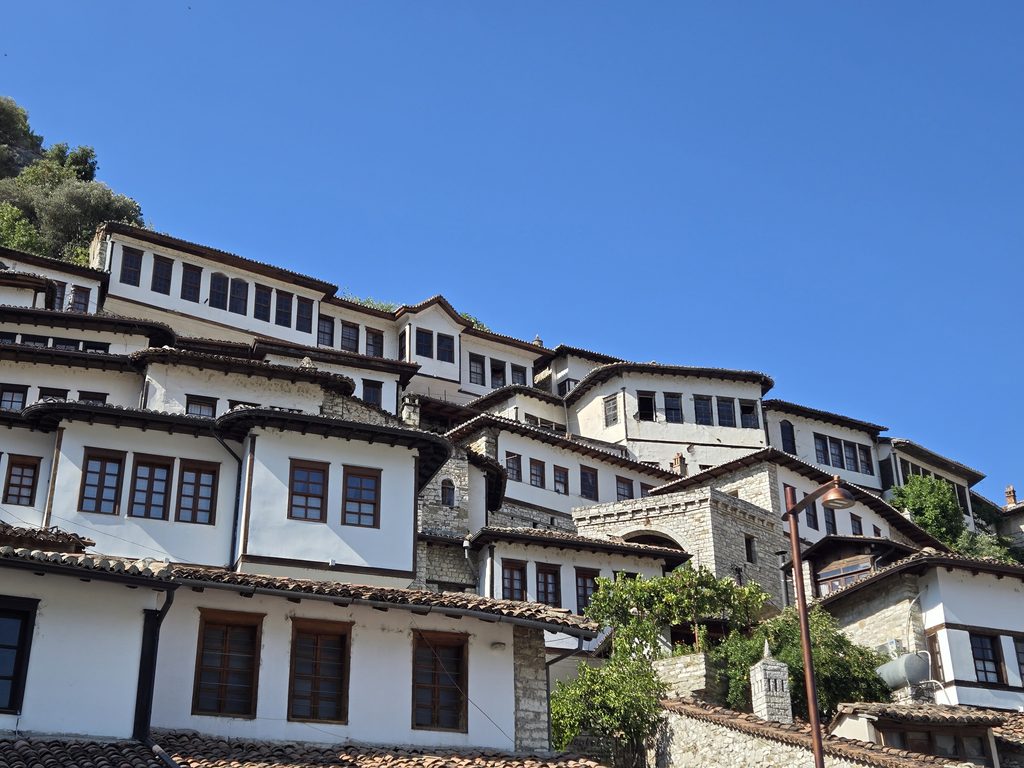
The famous homes of Mangalem district, which lend Berat the nickname of city of a thousand windows

I spent some time exploring Tirana as well. A small city, it still bears the legacy of the repressive and regressive years of Communist rule, a Communism that towards the end resembled the isolated cruelty of North Korea. The regime fell in 1991 and in its aftermath, the nation has been generally united in its culture and nationalism and tolerance, where differences of geography and religion don’t cause the type of strife common across the world (politics on the other hand…). The country is poor in European terms but look around Tirana and you will see it is rich with life. The streets, whether in residential or commercial districts, are lined with cafes with people enjoying a coffee (unfortunately tea is in short supply) and a conversation at all hours of the day. The evenings until the late hours are full of energy – not frenetic but comforting and familial.

The cuisine is also excellent. From what I could gather, from discussions with locals and starting to read through Ismail Kadare’s works, the Albanian point of view on the Ottoman era is mixed at best. The Albanian people, like most of the Balkans, are fiercely independent and proud so any occupation by empire or otherwise, especially one on the order of centuries, will evoke strong feelings. The legacy of the Ottoman occupation does persist, in part in the language, which is rather unique. Its tone and flow resemble Italian (insofar it sounds like people are always arguing but in fact they are carrying on regular, lively conversation) but the language itself has no surviving close relatives. There are enough Turkish loan words to deceive me into thinking I could understand it (though in reality the complexity of simple concepts like Hello – Përshëndetje – and Thank you – faleminderit – confounded me). The Ottomans left some of their culinary legacy as well and the Albanians have combined this with influences from Greece to its south, Italy just across the Adriatic sea, its own rich culture stretching back centuries to the Illyrians and before, and a land of bounty, with olive oil and wine flowing freely, to create a wonderful and diverse cuisine.

– – –

On my last day in Albania, I visited the House of Leaves, a former building of Albania’s secret police, the Sigurimi, a somber and chilling experience; bought a copy of Nasreddin Hodja in Albanian off of a street bookseller and had a lively but broken conversation on the nature of identity (he insisted I was indeed Albanian); and enjoyed a wonderful homemade meal and spent wonderful time with my family. I sipped on homemade Albanian raki, enjoying a complex and delightful taste of golden raisins, and tried Çaj Mali, a surprising and refreshing mountain tea. The conversation flowed around me in Turkish, Albanian, and English, folding me into the comfortable rhythms of a domestic Sunday.
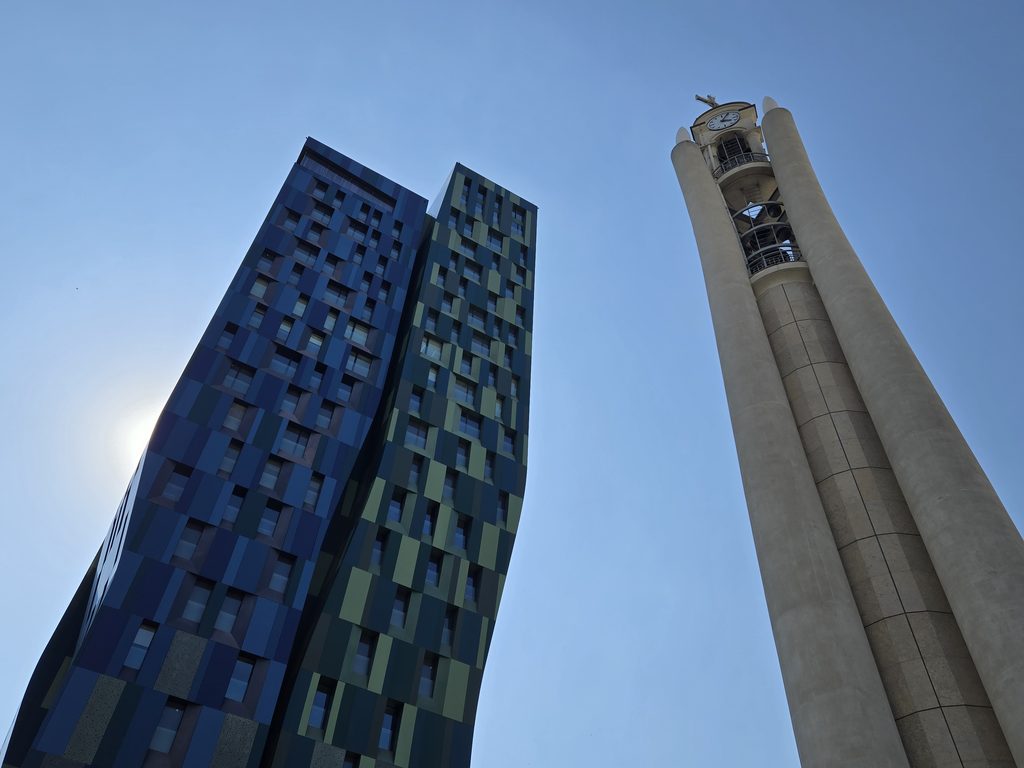
Tirana’s architecture is unique and can be surprisingly playful. Here modern towers stretch into the sun aside the spire of an orthodox church.

That evening, I attended the ongoing protests in Tirana. Called by some the Flamingo Revolution as they were sparked by a deal between the Albanian prime minister, Edi Rama, and our national son-in-law Jared Kushner to build a resort along a piece of pristine coast that is home to flamingos and other wildlife. The protests though are about much more, decrying the increasing cronyism of the Rama government, pushing for a better Albania with hope and opportunity as more and more youth are emigrating elsewhere. I attended on the 63rd consecutive night and as I write this they continue, reaching their 100th day. The demonstrations themselves are passionate but peaceful, emotional but not inflammatory, united in a common cause. On a sweltering summer night, attendance was strong, with children drawing on sidewalks with chalk, dozens of deep-red flags with Albania’s double-eagled crest billowing in the slight breeze, signs with messages of hope and change lending a sense of positivity in the face of despair.
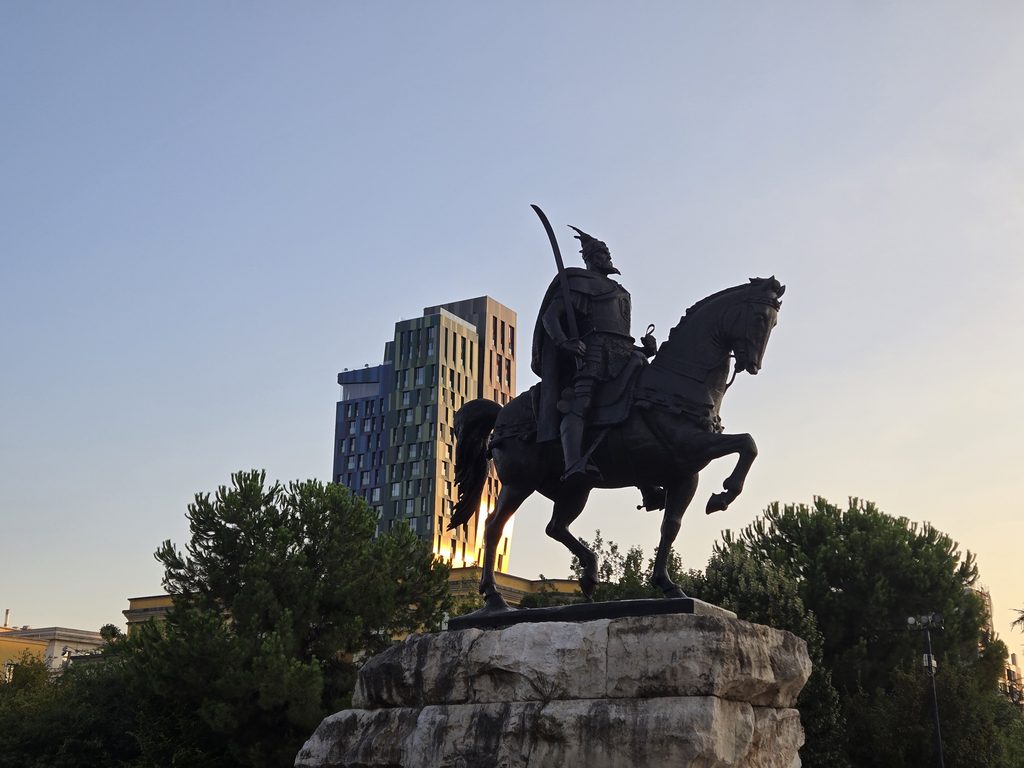
Statues and images (and souvenirs) of Skanderbeg, the Albanian national hero, are ubiquitous throughout the country

– – –

So am I Albanian? My great-great-grandfather, Mehmet Derrala, was an ethnic Albanian who for most of his life was an officer in the Ottoman military before fighting for the independence of his people: does that matter to me now, more than one hundred years later? Indeed, all of my great-great-grandparents from my mother’s side hail from ethnic Albanian lands. And so…? Is identity driven by family and blood, is it by citizenship and geography, is it local or regional or national? I think most of us would agree that ultimately it is what we as individuals choose to prioritize. But I also find that most people tend to keep their identities simple, removing complexities and conflicts of nature in favor of an ever smaller set of labels. It is so much more interesting when you embrace and explore nuance and difference. And so I have decided that, yes, I am indeed Albanian, as I am so many other things as well, and what that means to my identity, my personality, and my outlook on the world is something that will evolve with time and increased maturity. 
Categories
travel

Leros and the Art of Sitting

Life is fast. If ever there was a truism that captures the reality of our modern existence, this is the one. Life is fast, it is hectic, it is so much to handle, to juggle, to comprehend, to balance. It is constantly online, with seemingly the entirety of human information instantly at our fingertips, with the endless scrolling whose ultimate doom is the normalization of a mindless banality, the unnoticed departure of awe and wonder from our lives, the fixation on devices and virtual worlds at the expense of a connection with the world around us.

The stresses and anxieties imposed on us by the pace of our lives intrude even on our holidays. Time for vacation is limited, leading to pressure to optimize everything or at the very least make sure, make absolutely sure, that we are enjoying ourselves. This leads to checklists and packed itineraries and hours of sifting through reviews of tour operators and hotels – and that’s before we find ourselves struggling to disconnect from work email or spending valuable time formulating the social media post that shows the world what a good time we are having. We have turned boredom into a sin that must be avoided at all costs instead of embracing it for its qualities of peace and restoration. I wonder: am I also so afflicted by modern, digital life that I do not know how to unplug and disconnect?

Enter Leros, an island in the Dodecanese in the southern Aegean, less than an hour away by ferry from the port at Turgutreis near Bodrum. I visited this charming Greek throwback to decades past with my cousin this summer, spending a few days swimming its wonderful waters, feasting on its glorious food, and absorbing its relaxed and unhurried vibe. The customs house on arrival is an introduction to a laid-back attitude: a small building, a shack really, whose officers were at best sleepy and quite possibly actually asleep. The queue was long and slow, provoking peevish complaints from a few people, who unfortunately had lost the plot on the first page during their very first moments on its shores. The point is to embrace and bask in the slowness, to appreciate it for what it is: the refutation of that pernicious truism that Life is Fast.

The morning, and throughout our short three-day stay, strong winds buffeted the island with some gusts so unexpectedly strong they pushed you over without warning. Whenever I visit the Aegean I find myself pondering the ancient sailors of this beautiful sea. The more time you spend in the area you begin to understand not only how connected the islands and the coast were but also how easily each island and peninsula could develop its own intrinsic cultures. Each place is but a hop, skip, and a jump away from another but even in our modern world our large ferries and ships struggle with adverse conditions in the sea. (Our own trip was rescheduled for an hour earlier to avoid the worst of the wind though it seems no one told the customs officers, who showed up to process the original time and received sardonic applause from the crowd upon their arrival.) For the ancients, no matter their expertise and experience, navigating the seas in these conditions would have been impossible. So you stay at home, rely on the fruits of your own land and seas, and over time build a culture both connected and unique to the world around you.

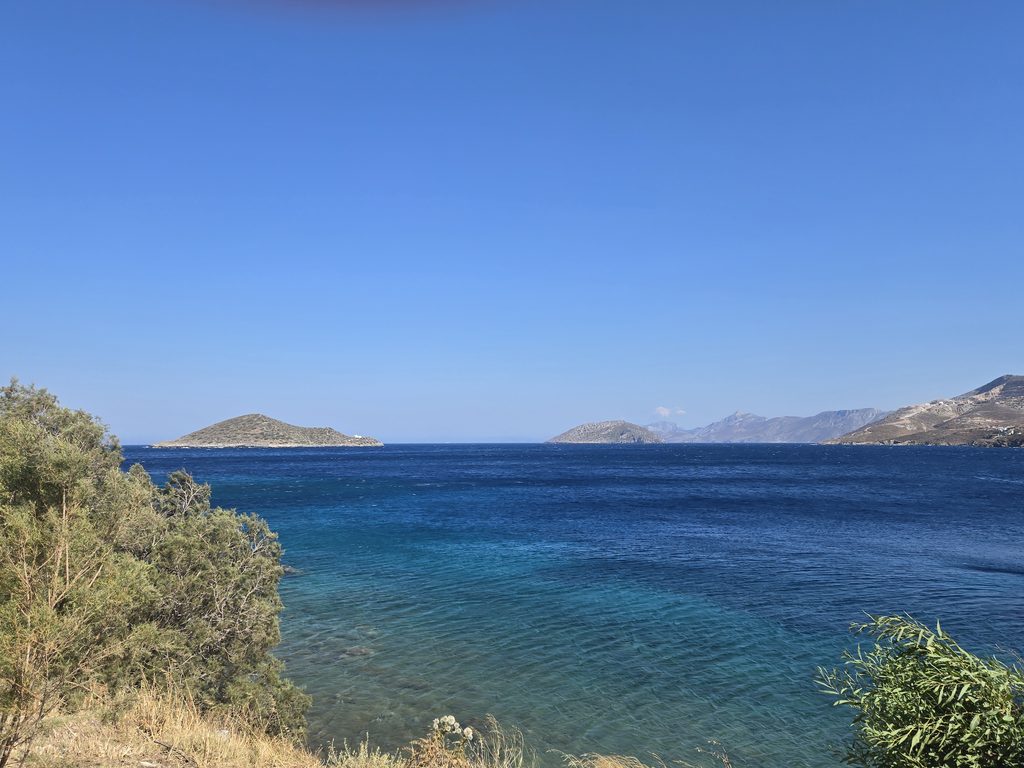
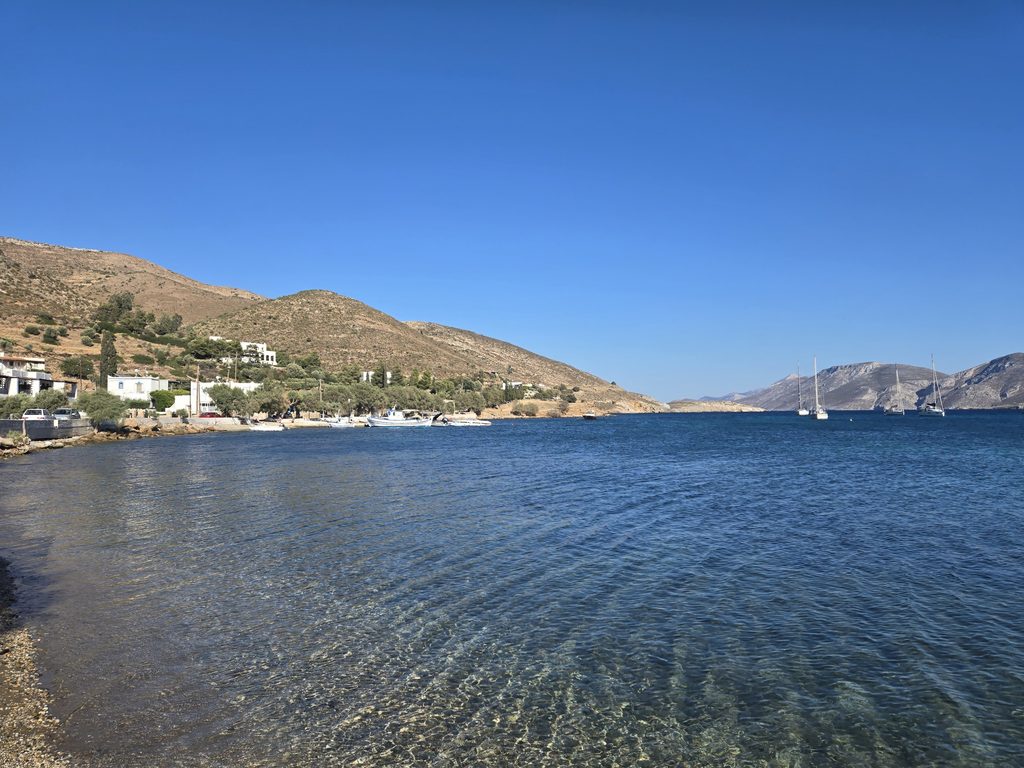
The calm atmosphere and clear waters of Xirocampos Beach

Thankfully the geography of Leros is craggy, providing several coves sheltered from the wind by hills and bluffs. The beaches are busy but uncrowded: these are not wide stretches of beach off the beaten path but nor are the chaise longues packed like sardines. The beaches are small and pebbly, lined by restaurants that provide sunbeds as long as you enjoy (and enjoy you will) their food and drink. Large hotels, and hotels in general, are absent and lodging is more on the order of guesthouses and hostels. Aside from Greek of course, Turkish is the prevalent language, as Turkish visitors are drawn to the beauty and affordability of the island to escape the never-ending cost-of-living crisis in their country.

We visited three beaches, each with its own character: Panteli Beach, a short walk from our lodging, the most crowded of the lot but lovely with its white-on-turquoise aesthetic; Xirokampos Beach in the south of the island, the most peaceful, serviced only by two restaurants, its waters calm and wonderful for swimming; and Lime Beach, the trendiest one with fancy sunbeds and incessant (and unfortunately just a touch too loud) lounge music but waters where I most enjoyed my long swim. 

Panteli Beach on its outer edges, where the cove meets the open sea

Many visitors rent cars, small things really, to traverse what is not that large of an island – probably less than 30 minutes from tip to tip. My cousin and I took taxis. My cousin has been learning Greek and not only is it more than passable it is very impressive, impressive enough that she became fast friends with Stella, who soon became our go-to taxi driver. Oh Stella! What a vibrant personality! Never learning my name, she simply called me signor, which was lovely indeed.

It was through Stella that I realized that life itself was not necessarily idyllic on this idyllic island. One of only two women taxi drivers (her friend picked us one time and admonished us to buckle our seatbelts), her life was one of hustle and bustle, driving hours each day transporting tourists to and fro. There are certainly worse places to hustle than Leros but it is still the type of hustle that most of us can understand. Bills must be paid. She was a lovely person and gave us a hug after our final ride back to the marina.

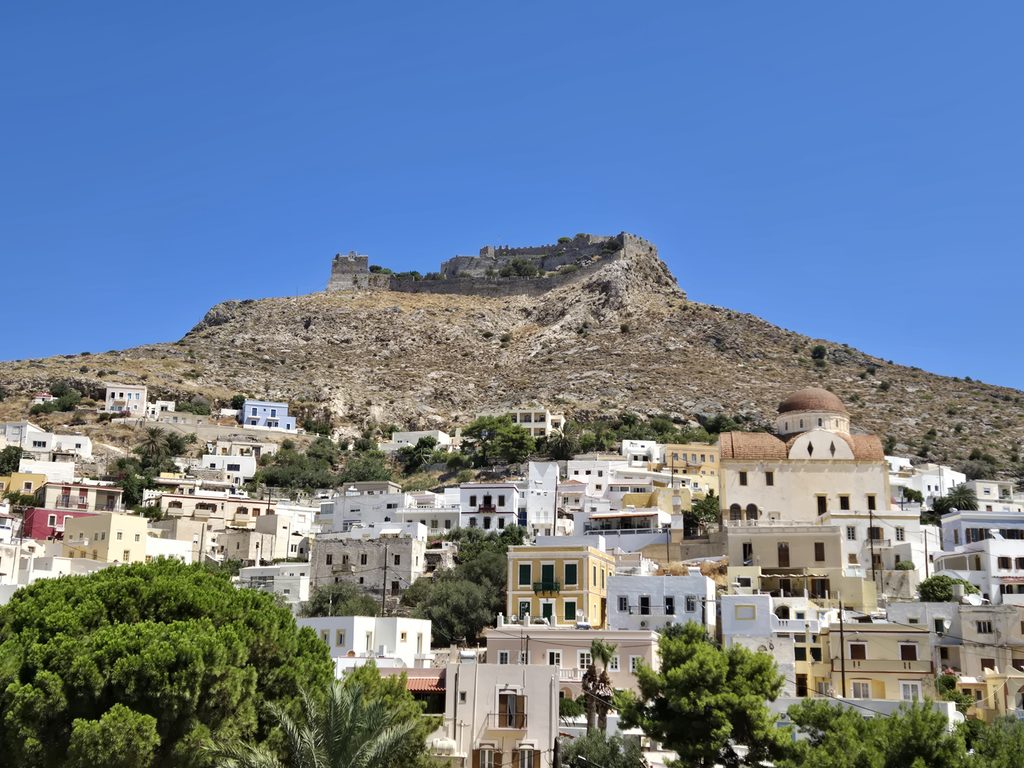
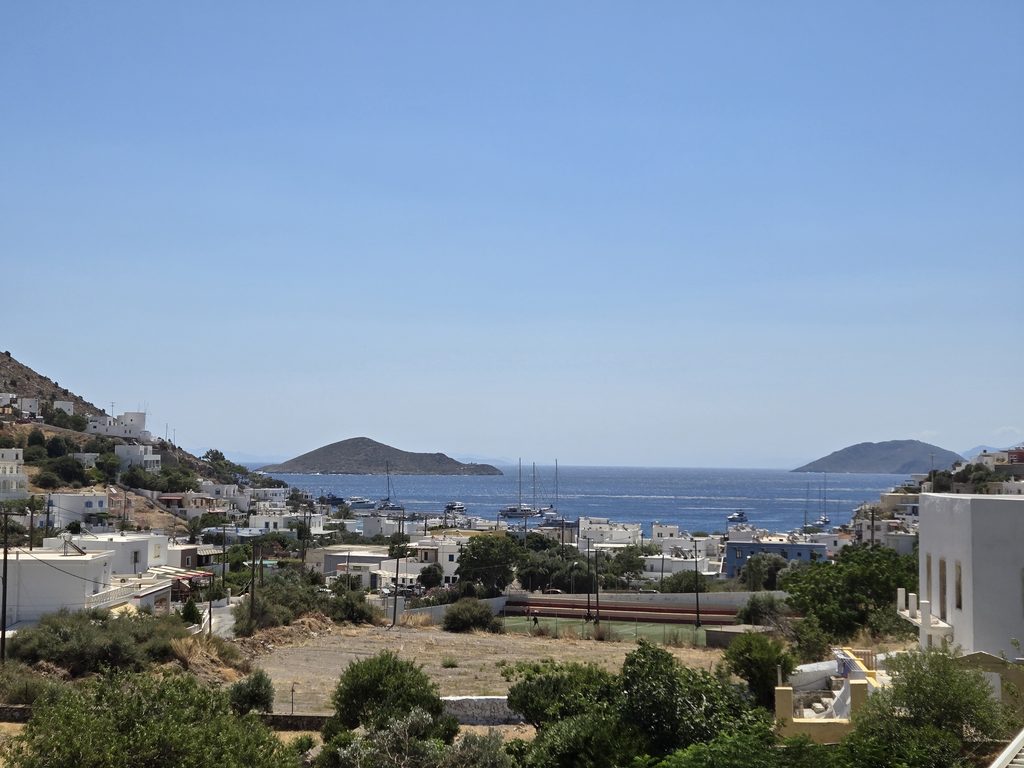
Even with the hustle, the atmosphere of the island is one of tranquility. It is one of those places, those few remaining places, where people just sit. Whether on their balconies or in front of their home, some people sit, either alone or in company, and pass the time observing the world around them. I noticed this as I tried out balcony-sitting myself, easy enough as the view from the lodging was incredible: the old castle on a hill straight ahead, the village with its homes and their clothing lines, its many multi-colored churches, and its winding roads traversing the hill’s slopes; and, to the right, beyond a small football field where children played for hours in the evening, not too far into the distance, was Panteli Beach, its blue waters entrancing from the morning sunlight to the twilight of dusk. The soundtrack was a general quiet with occasional movements of birdsong and church bells.

The view from my balcony, which grew lovelier as the day grew long
Looking to the right from the balcony reveals Panteli Beach in the distance.

Across the way, I saw a family sitting on their own balcony. My eyes are not the sharpest but they seemed to be unmoving, sitting there not with a particular purpose but for the sake of sitting, in each other’s company and I assume in conversation, sparse though it might be. Like a junkie with a hankering, I was soon drawn inside because the WiFi signal was weak outside but returning some time later I saw them again on the balcony, seemingly not having moved at all.

Likewise, on our way down to Panteli one afternoon, my cousin and I passed by a woman sitting in front of her home and exchanged a Kalimera and a smile. Several hours later, she was still there, and the Kalimera had become a Kalispera. Since then I have thought much on the art of sitting, with your own thoughts, unbothered, unbored, a part of the environment around you. It is like meditation but not really. There are no trappings of a practice. It is simply something that one does. I tried it myself but found it difficult, growing antsy, reaching for my phone or (more wholesomely at least) my book. Perhaps one day I will more easily attain the utter peacefulness of sitting without purpose and simply letting life flow around and through me without agenda.

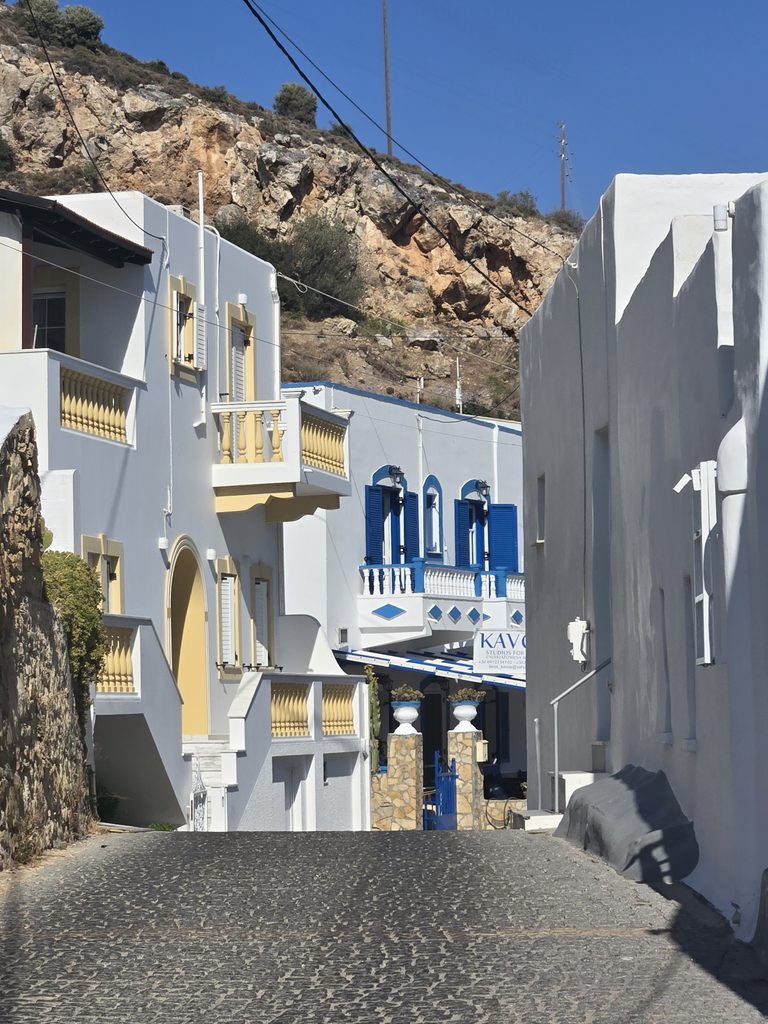
The bright white and bright colors of Aegean architecture in their fullest expression

There are of course other ways to relax and enjoy a holiday than simply sitting. Spending unhurried hours on the beach and in the water, with no real pressure except perhaps a reservation for dinner that feels rather malleable anyway, leaving your place in the sun only to feast on fresh seafood, served with cool and tart white wine or a bit of ouzo… this is a perfect setting, where the stresses of quotidien life seem a lifetime and a world away. It is a lovely existence on Leros and long may it continue as such, both there and on dozens of other islands in the Aegean and Mediterranean Seas that have avoided the throngs of selfie-seekers that many of their counterparts have fallen prey to. 

Alas, the day has but 24 short hours and the world is governed by schedules and appointments. The relaxed approach to island living can be intoxicating but also frustrating when actually pressed for time. My cousin and I sat down for a late lunch with plenty of time before our embarkation for the trip back home but the slow life has no respect for departure times. A simple lunch order, acknowledged by a brief nod, had not even been started to be prepared a half hour later, everyone in the cafe seemingly unhurried and unbothered by it all. If anything, the young waiter seemed startled that I had interrupted his own extended spell of sitting. I can’t blame him.

Instead we made do with a gyro, which itself took quite some time to prepare but was nevertheless delicious despite having to wolf it down under an angry sun while waiting for the unbothered customs officials to process our queue. It was in retrospect for me an ideal final touch to cap off previous meals of fresh and delicious yogurt bowls with local honey and fruit and tahini, seafood and roasted meats of the highest quality, and at Serza Leros one of the finest meals I have had in quite some time. Not to mention a very lovely breakfast hosted by my cousin’s friend, who she quite serendipitously ran into while waiting for our ferry to depart at the beginning of the trip.

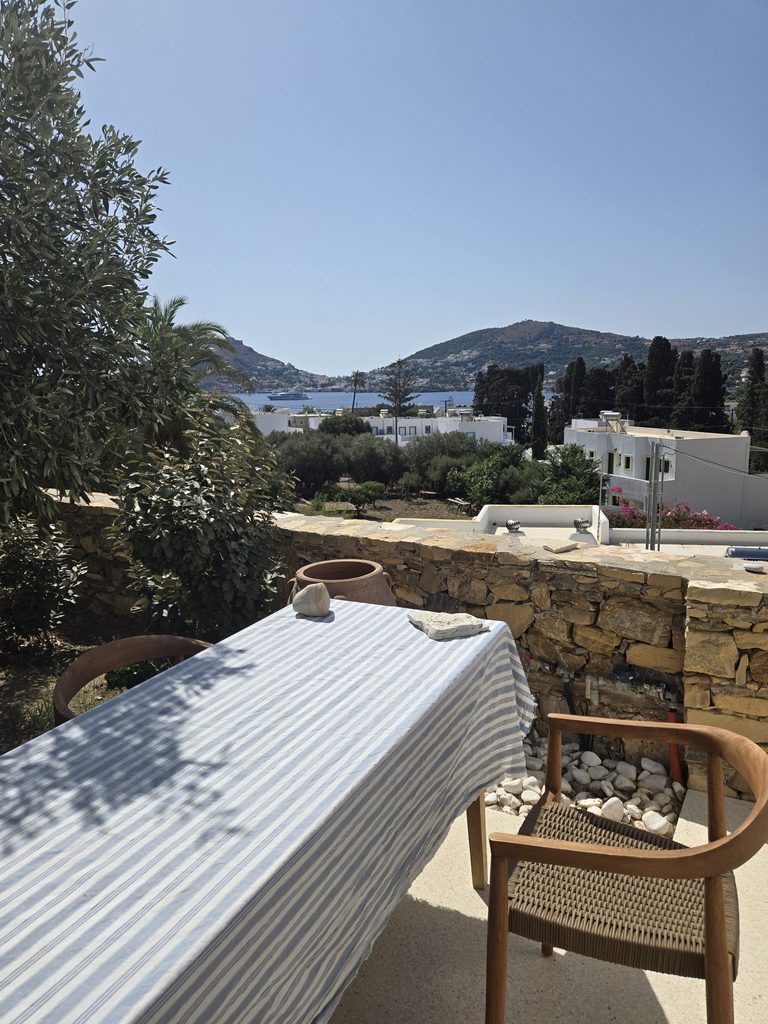
The perfect setting for a breakfast (before the table was filled to its brim)

My visit to Leros was halfway through a month-long trip to Turkey and it somewhat ironically turned out to be the transition from a lazy vacation, where my only concern was tanning without burning, to a whirlwind of activity. Two days later I was in Albania, where I pondered the nature of my identify, and soon after that return, I was in Istanbul, sandwiching a trip to the slopes of the Kazdaglar, known to the ancients as Mount Ida, from whence Zeus observed the Trojan War. Ah, this lovely world and its never-ending wonders!